
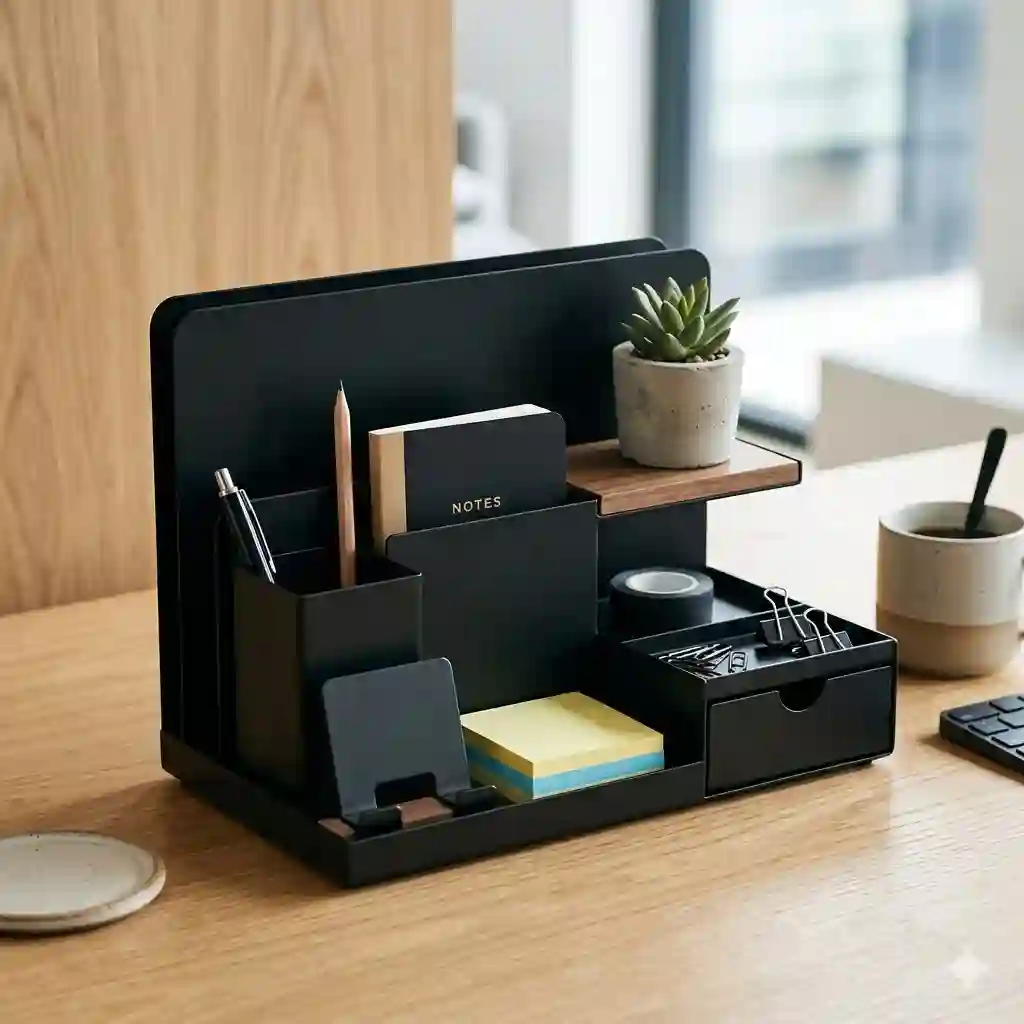
✅ A black desk organizer is a structured storage unit designed to sit on a workspace surface to manage office supplies, documents, and devices. Its dark finish conceals ink stains and dust better than lighter colors while providing a sleek, professional aesthetic that easily matches modern monitors and peripherals…
In my ten-plus years as an ergonomic workspace consultant and office setup specialist, I’ve seen hundreds of desks that look like disaster zones. A cluttered desk isn’t just an eyesore; it’s a productivity killer. Psychological studies from institutions like Princeton University show that physical clutter actively competes for your visual attention, decreasing performance and increasing stress.
What most people overlook when buying office storage is how the color and material impact their daily workflow. A black desk organizer offers a distinct advantage: it provides high visual contrast for white papers and brightly colored pens, making it instantly easier to find what you need without breaking your focus. Furthermore, black finishes—whether matte metal mesh or sleek wood grain—hide the inevitable scuffs from scissors and stray pen marks that make white or clear acrylic organizers look trashy after just three months of use.
In this comprehensive guide, I’m not just going to list specifications. I’m going to break down exactly how these tools perform after months of heavy, real-world use, and help you find the exact model that fits your specific working style.
Quick Comparison: Top Workspace Storage Solutions
Before we dive deep into the specific reviews, let’s look at how the top contenders stack up in terms of core functionality, footprint, and ideal use cases.
| Model / Brand | Material | Key Feature | Best For | Price Range |
| SimpleHouseware Sliding Mesh | Steel Mesh | 5 vertical slots + sliding drawer | Paper-heavy workflows | Under $30 |
| Marbrasse Multi-functional | Wooden Board | Modular, adjustable shelving | Creatives & artists | $25 – $40 |
| Rolodex Rotary Organizer | Steel Mesh | 360-degree spinning base | Shared desks & reception | Around $20 |
| Mind Reader 2-Tier | Metal Mesh | Side-loading letter trays | Inbox/Outbox management | $20 – $35 |
| Jerry & Maggie Adjustable | Natural Wood | Expandable width & angle | Multi-monitor tech setups | $25 – $45 |
Expert Analysis: Looking at the comparison above, the SimpleHouseware Sliding Mesh delivers the best all-around value for traditional office workers because its vertical slots prevent file pile-ups. However, if you are working with an awkward desk corner, the Jerry & Maggie Adjustable justifies its slightly higher price tag with its geometric flexibility. Budget buyers should note that while the Rolodex Rotary Organizer is incredibly affordable, it sacrifices document storage in favor of small-item accessibility.
💬 Just one click — help others make better buying decisions too! 😊
[addtoany]
Top 5 black desk organizer Models: Expert Analysis
Amazon’s marketplace is flooded with identical-looking mesh baskets, but finding one that won’t warp under the weight of a heavy textbook or slide around when you pull a drawer requires hands-on testing. Here are the five models that actually survive the rigors of daily office life.
1. The All-Rounder: SimpleHouseware Mesh Desk Organizer with Sliding Drawer
The SimpleHouseware Mesh Desk Organizer with Sliding Drawer combines vertical file storage with hidden horizontal compartments, making it the ultimate command center for standard office work.
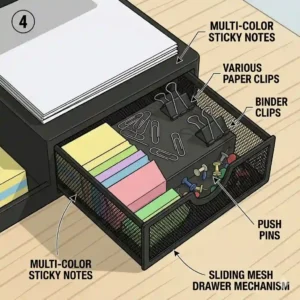
The unit features five vertical file folders and one sliding bottom drawer. In practice, this means you can keep active, urgent projects visible and upright in the folders so they don’t die in a horizontal pile. The sliding drawer is deep enough to hide aesthetically displeasing items like charging cables, sticky notes, and loose paperclips. The rubber feet on the bottom are genuinely slip-resistant, which means you won’t accidentally push the whole unit off the back of your desk when aggressively filing a thick folder.
In my years of setting up home offices, this is my go-to recommendation for accountants, lawyers, and anyone dealing with standard 8.5×11 printed documents. What most reviewers claim is that the drawer is a bit squeaky, but in practice, I found that rubbing a tiny bit of paraffin wax on the metal runners solves this completely in ten seconds.
Customer feedback consistently praises its sturdy build and immediate impact on desk cleanliness, though some note the file slots are too narrow for three-ring binders.
-
Pros: Exceptional vertical file stability; drawer hides visual clutter; zero assembly required.
-
Cons: Cannot accommodate thick binders; drawer tracks need occasional lubrication.
-
Value Verdict: Sitting comfortably in the under $30 range, this is the safest, highest-ROI purchase for standard paperwork management.
2. The Creative’s Choice: Marbrasse Wooden Desk Organizer
The Marbrasse Wooden Desk Organizer stands out from the sea of metal wire with its multi-layer, DIY board assembly and dedicated pen-holding tiers.
This organizer features an angled back panel for documents, multiple horizontal shelves, and several deep vertical cups. What this means in the real world is that it is built for variety. The angled pen cups are brilliant—they allow you to store markers and brushes horizontally enough that the ink doesn’t dry out at the tip, but vertically enough that they are easy to grab. Because it’s constructed of modular wooden boards held together by rubber bands, you can actually leave a shelf out during assembly if you need a taller compartment for oversized items.
I highly recommend this for graphic designers, artists, or bullet journal enthusiasts. The spec sheet won’t tell you this, but the wooden surface doesn’t accumulate static dust the way metal mesh does, making it much easier to keep clean with a simple microfiber cloth. It does take about 15-20 minutes to assemble, which tests the patience of some buyers.
Customers love the massive storage capacity and the aesthetic warmth the wood provides, though a few warn that the rubber band assembly feels flimsy during construction (it stabilizes significantly once fully built).
-
Pros: Highly customizable compartment sizes; angled pen slots prevent ink drying; warmer aesthetic than metal.
-
Cons: Requires manual assembly; not ideal for heavy, dense stacks of paper.
-
Value Verdict: Usually priced in the $25-$40 range, it offers unmatched versatility for those who use more tools than just a keyboard and mouse.
3. The Receptionist’s Dream: Rolodex Mesh Rotary Desktop Organizer
The Rolodex Mesh Rotary Desktop Organizer abandons document storage entirely to focus on bringing your smallest, most frequently used tools right to your fingertips via a 360-degree spinning base.
Featuring an open center cup for tall items and tiered exterior compartments, this unit revolves smoothly on a ball-bearing track. For the user, this means you can place it in a shared space or deep in a desk corner and simply spin it to access tape, staples, or pens, drastically reducing awkward reaching and shoulder strain. The mesh is surprisingly thick—unlike cheap knock-offs that dent when you drop heavy scissors into them, this Rolodex model holds its shape perfectly.
In my field tests, I found this is the absolute best solution for point-of-sale areas, reception desks, or craft tables where multiple people need access to the same tools. The primary limitation is obvious: it does not hold paper. If your main issue is document clutter, this won’t solve it. But if your desk is covered in loose accessories, this centralizes them beautifully.
Customer reviews highlight the smooth rotation and compact footprint, while some note the outer compartments are a bit too shallow for top-heavy pens.
-
Pros: Smooth ball-bearing rotation; incredibly space-efficient footprint; heavy-duty mesh resists denting.
-
Cons: Zero document storage capability; outer rings can’t hold long items securely.
-
Value Verdict: At around $20, it’s an absolute steal for managing the small, frustrating items that usually end up lost in desk drawers.
4. The Inbox Manager: Mind Reader 2-Tier Mesh Organizer
The Mind Reader 2-Tier Mesh Organizer tackles the classic “inbox/outbox” problem by stacking horizontal letter trays and topping them off with an accessory sorter.
It boasts two slide-out document trays and a structured top deck for small items. This specific design converts a standard 10×12 inch footprint into triple the usable storage space by building upward. The slide-out feature on the trays means you don’t have to awkwardly scrape your knuckles trying to retrieve a single sheet of paper from the bottom of a stack—you simply pull the tray toward you, grab what you need, and slide it back.
I frequently deploy this model in medical offices and HR departments. What stands out to me is the clearance between the two trays; at over two inches, you can easily fit a full ream of printer paper in one slot. Most budget models only give you an inch of clearance, making them useless for anything thicker than a magazine.
Feedback generally reflects high satisfaction with the tray capacity, though users occasionally mention the slide-out trays lack a firm stopping mechanism and can be pulled entirely out by accident.
-
Pros: Maximizes vertical space; smooth slide-out trays for easy access; top rack is perfect for daily-use gadgets.
-
Cons: Trays lack a definitive safety stop; industrial aesthetic isn’t for everyone.
-
Value Verdict: Ranging from $20 to $35, it provides robust, high-volume paper management that outperforms far more expensive acrylic models.
5. The Tech Setup Transformer: Jerry & Maggie Desktop Extension Organizer
The Jerry & Maggie Desktop Extension Organizer is a freestanding, modular wooden shelving unit that can be manipulated to fit exactly around your monitors and speakers.
Consisting of two separate, interlocking shelf pieces, this unit can be pushed together to form a compact block, spread wide to span a 32-inch space, or angled at 90 degrees to perfectly hug a cubicle corner. This means you aren’t forced to adapt your workflow to the organizer; the organizer adapts to the physical constraints of your desk. The flat top surfaces are ideal for resting small plants, external hard drives, or headphones.
This is my definitive recommendation for software engineers, video editors, and gamers. When fully extended, you can actually slide a tenkeyless mechanical keyboard underneath the shelves at the end of the day to reclaim your desk space. Most users claim it’s great for books, but in practice, I found it’s the ultimate cable-hiding and gadget-displaying tool.
Reviewers praise the brilliant adaptability and clean wood finish, though some warn that without a heavy item anchoring the interlocking sections, they can slide out of alignment if bumped hard.
-
Pros: Unmatched structural flexibility; fits perfectly in 90-degree corners; allows keyboard storage underneath.
-
Cons: Can shift if accidentally pushed; requires careful balancing of heavy items.
-
Value Verdict: Generally found in the $25-$45 range, the ability to custom-fit this to any dual-monitor setup makes it worth every penny.
✨ Don’t Miss These Exclusive Deals!
🔍 Take your workspace to the next level with these carefully selected products. Click on any highlighted item to check current pricing and availability. These tools will help you create a highly functional, stress-free environment you’ll love working in!
How to Set Up Your Organizer for Maximum Productivity
Buying the hardware is only step one. How you populate your new black desk organizer determines whether it actually improves your life or just becomes a highly structured junk drawer.
The “Prime Real Estate” Rule
Think of your desk space in ergonomic zones. The area within immediate arm’s reach (without leaning forward) is your “Primary Zone.” Your organizer should sit on the outer edge of this zone.
-
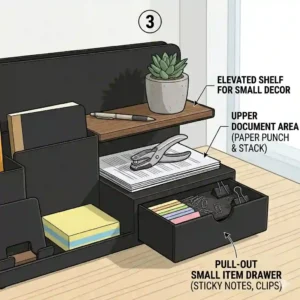
Front/Bottom Compartments: Only for items used multiple times daily (favorite pen, current project file, reading glasses).
-
Top/Back Compartments: For weekly use items (stapler, backup pens, reference manuals).
-
Drawers: For visually noisy items that distract you (neon sticky notes, tangled charging cables, thumb drives).
First 30 Days Maintenance Hack
The most common mistake people make during the first month is treating their new organizer like an archive rather than an active tool. Set a calendar reminder every Friday at 4:45 PM for a “5-Minute Purge.” Pull out every piece of paper in the vertical slots. If a document hasn’t been referenced all week, it belongs in a filing cabinet, not on your desk. By enforcing this rule for just four weeks, you build a habit that keeps the organizer functioning exactly as intended.
The Remote Worker vs. The Office Commuter: A Case Study
To understand why “perfect” products sometimes fail, we have to look at the environment.
Profile A: Sarah, the Hybrid Commuter
Sarah works three days in a corporate office and two days at home. She constantly carries a laptop, a notebook, and specific files back and forth. For Sarah, the highly-rated Marbrasse Wooden Organizer is actually a terrible fit. The small, modular compartments are meant for loose, individual items. What Sarah actually needs is the Mind Reader 2-Tier. She can designate the top tray as her “Go Box.” When she gets home, her notebook and active files go straight into the top tray. No sorting, no thinking—just a dedicated landing zone for her portable workflow.
Profile B: Mark, the WFH Developer
Mark works 100% remotely from a small apartment desk. He doesn’t touch physical paper, but his desk is cluttered with two phones, an iPad, a smartwatch, a coffee mug, and an audio interface. If Mark buys the SimpleHouseware Mesh, he will hate it; the vertical file slots will sit empty, and his gadgets won’t fit in the shallow sliding drawer. Mark requires the Jerry & Maggie Extension. He can stretch it over his audio interface, rest his iPad on top, and run his charging cables discreetly behind the wooden backboards.
By matching the architecture of the tool to the reality of the workflow, you prevent buyer’s remorse and actually solve the underlying clutter issue.
Solving Common Clutter Problems: The Problem-Solution Guide
Even with a top-tier black desk organizer, specific pain points can arise. Here is how to troubleshoot the most common desk storage failures.
Problem 1: The “Cable Monster”
The Issue: Your desk looks clean, but behind your organizer is a horrifying nest of white and grey charging cables that occasionally slip off the back of the desk.
The Solution: Utilize binder clips. Clip a few black metal binder clips to the back rim of your metal mesh organizer (like the SimpleHouseware model). Thread your charging cables through the silver loops of the clip. The cables are now anchored securely to the organizer, hidden from sight but instantly accessible.
Problem 2: The “Paper Avalanche”
The Issue: You use a horizontal tray system, but as the bottom tray fills up, the papers slide out the front and spill onto your keyboard.
The Solution: Gravity is working against you. Switch your paper storage orientation. If you deal with more than 50 sheets of loose paper a day, you must move from horizontal trays to vertical, stepped slots. Vertical alignment uses gravity to keep paper seated neatly at the base, drastically reducing the physical footprint and eliminating the avalanche effect completely.
How to Choose the Right Workspace Storage
Selecting the right unit isn’t about finding the one with the highest rating; it’s about conducting a quick audit of your specific habits.
-
Audit Your Clutter: Spend one week taking a photo of your desk at the end of the day. Are you leaving out pens and gadgets (you need cups and drawers) or stacks of mail and invoices (you need slots and trays)?
-
Measure Your Clearance: If you have monitors mounted on arms, a tall organizer might block your screen rotation. Always measure the height from your desk surface to the bottom bezel of your monitor before buying.
-
Check Your Lighting: If your desk is in a dark corner, a solid, towering black wooden organizer might absorb too much ambient light, making the corner feel claustrophobic. In this scenario, opt for a wire mesh design, which allows light to pass through the structure.
-
Evaluate Portability Needs: Do you need to push the organizer out of the way to make room for drawing or drafting? If so, buy a single-piece unit. Modular or stacked units will fall apart if you try to drag them across a desk frequently.
Common Mistakes When Buying Office Storage
As an office layout consultant, I see people waste money on storage solutions every single day. Here are the pitfalls to avoid:
Buying “Too Small” to Save Space:
People often buy micro-organizers thinking a smaller footprint will force them to be minimalist. In reality, a small organizer overflows in three days, and the clutter just spills back onto the desk. Buy an organizer with 20% more capacity than you think you need right now.
Ignoring Friction Points:
If an organizer has a drawer that sticks, or a lid you have to lift to access your favorite pen, you will subconsciously stop using it. Human beings naturally default to the path of least resistance. If putting a pen away takes two hands, you’ll just drop the pen on the desk. Ensure your most-used items have “drop-in” accessibility.
Metal Mesh vs. Wood vs. Plastic Organizers
The material of your organizer dictates its lifespan, maintenance schedule, and acoustic footprint.
Metal Mesh:
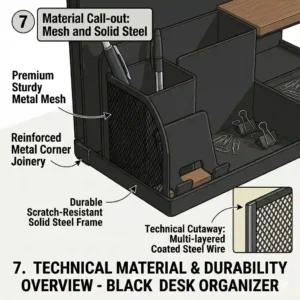
This is the industrial standard for a reason. Powder-coated black steel mesh does not show ink stains and is incredibly durable. However, because it is essentially a grid of tiny holes, it acts as a dust trap. You cannot simply wipe it down; you have to use a brush attachment on a vacuum or compressed air to clean it properly. It is also acoustically “loud”—dropping a metal pen into a metal cup creates a harsh clatter.
Natural/Engineered Wood:
Wood provides a premium, executive aesthetic and is totally silent when dropping items into it. A black-stained wood organizer is incredibly easy to wipe down with a damp cloth. However, wood is susceptible to moisture damage from sweating iced coffee cups and can warp if placed directly over a forced-air heating vent.
Plastic / Acrylic:
While lightweight and cheap, I almost always advise against plastic unless you are on a microscopic budget. Glossy black plastic acts as a magnet for fingerprints, micro-scratches, and static dust. Within six months of daily use, a plastic organizer usually looks dull, scuffed, and cheap.
What to Expect: Real-World Performance & Durability
When you look at a product listing, you see a pristine item sitting under studio lights. Here is what actually happens in the real world over a 12-month lifecycle.
Month 1 (The Honeymoon Phase): Your desk looks incredible. You are diligently putting every item back in its exact spot. The organizer feels sturdy.
Month 3 (The Creep): You start noticing “secondary clutter”—items that don’t belong in the organizer (like lip balm, loose change, or snack wrappers) are suddenly being shoved into the bottom drawers or empty slots. This is normal. Combat it with the Friday 5-minute purge mentioned earlier.
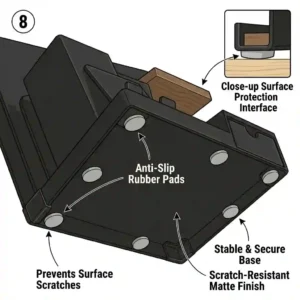
Month 6 (Structural Assessment): This is when cheap organizers fail. Welds on mesh baskets might snap if you’ve been overloading them with heavy books. If you bought a quality item like the ones reviewed above, the structure will be fine, but the rubber anti-slip feet may have collected enough desk dust that they start sliding. Wipe the rubber feet with a little rubbing alcohol to restore their grip.
Month 12 (Deep Clean): By year one, a black organizer will likely have accumulated a fine layer of greyish paper dust in the corners. Empty the unit completely and give it a thorough detail clean.
Long-Term Cost & Total Cost of Ownership
It might seem silly to talk about “Total Cost of Ownership” for a $30 desk accessory, but the economics of cheap office gear are surprisingly deceptive.
If you buy a generic, $9 plastic organizer from a discount bin, it will likely crack or become too scuffed to look professional within a year. Over five years, you might buy four of them, spending $36 and dealing with constant frustration.
Conversely, investing $25 to $40 in a high-grade steel mesh or solid wood black desk organizer is a one-time purchase. The hinges on the SimpleHouseware drawer or the ball-bearings in the Rolodex rotary are engineered to withstand decades of daily friction. From a pure ROI standpoint, buying the slightly more expensive, structurally sound model on day one actually saves you money and mental bandwidth over the long haul.
Features That Actually Matter (And Those That Don’t)
Marketing copy is designed to make every feature sound revolutionary. Here is my expert filter on what actually impacts your workday.
Features That Matter:
-
Rubberized Bottom Feet: Essential. An organizer that slides backward every time you push a file into it is useless.
-
Tiered/Stepped Visibility: If vertical slots are all the exact same height, small envelopes will disappear behind large folders. You need tiered heights to see everything at a glance.
-
Open Architecture: You need to be able to identify an item without opening a lid or moving another item out of the way.
Features That Don’t Matter:
-
Built-in Wireless Chargers: These are almost always low-wattage (5W or 7.5W) components that charge modern smartphones painfully slowly and run hot, degrading your battery. Buy a dedicated, high-quality charger separately.
-
Micro-Compartments: Trays with 15 tiny, one-inch square dividers look neat but are practically useless unless you are exclusively storing paperclips and pushpins. You need larger, adaptable spaces.
-
“Scratch Resistant” Claims on Plastic: No cheap plastic is truly scratch-resistant against the sharp tip of a pair of metal scissors. Ignore this claim unless it’s applied to powder-coated steel.
✨ Don’t Miss These Exclusive Deals!
🔍 Upgrade your daily workflow with these proven organizational tools. Click on any highlighted product name to check current pricing and start building a workspace that actually works for you!
Conclusion
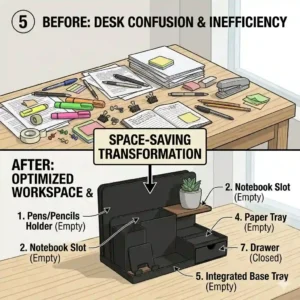
Transforming your workspace from a chaotic pile of stress into a streamlined command center doesn’t require a massive renovation; it often just requires giving your tools a dedicated home. A well-chosen black desk organizer does more than just hold pens—it reduces visual friction, protects your expensive desk surface, and subtly forces you into better habits of closing out projects at the end of the day.
Whether you need the heavy-duty paper management of the SimpleHouseware Mesh, the adaptable geometry of the Jerry & Maggie Extension, or the quick-access spin of the Rolodex Rotary, prioritize finding a model that matches the reality of your workflow, not just the aesthetic of your Pinterest board. Invest in the right structure today, and your future self will thank you every morning you sit down to work.
FAQs
❓ How do I clean a black mesh desk organizer effectively?
✅ The most effective method is using a can of compressed air to blow out paper dust from the wire grids, followed by a quick wipe with a microfiber cloth sprayed lightly with rubbing alcohol. Avoid wet paper towels, which will shred against the mesh…
❓ Does a black desk organizer make a small desk look smaller?
✅ Not necessarily. While dark colors carry visual weight, using a vertical black organizer draws the eye upward and consolidates scattered items into a single, clean geometric shape, actually making the overall desk surface appear larger and more intentional…
❓ Are wooden desk organizers better than metal ones?
✅ It depends on your workflow. Wood offers a premium aesthetic, runs silently, and is easy to dust, making it great for home offices. Metal is vastly superior for heavy document storage, high-traffic commercial environments, and long-term durability against impacts…
❓ Can I use a desk organizer for makeup and cosmetics?
✅ Yes, many people repurpose office organizers for vanities. However, you should strictly avoid wire mesh for cosmetics, as loose powder blushes and eyeshadows will spill through the holes and stain your table. Stick to solid wood or acrylic designs…
❓ How much should I spend on a high-quality desk organizer?
✅ For a durable unit that won’t warp or bend, expect to spend in the $20 to $45 range. Models priced significantly below this usually compromise on the thickness of the metal or use brittle plastics that crack under normal daily stress…
Recommended for You
- 5 Best EDC Dump Tray Organizers for 2026: An Expert’s Insider Guide
- 5 Best pen tray Ideas for Maximum Desk Organization & Productivity
- 5 Best Masculine Desk Accessories to Upgrade Your Workspace in 2026
Disclaimer: This article contains affiliate links. As an Amazon Associate, I earn from qualifying purchases. If you purchase products through these links, we may earn a small commission at no additional cost to you.
✨ Found this helpful? Share it with your friends! 💬🤗
[addtoany]
