
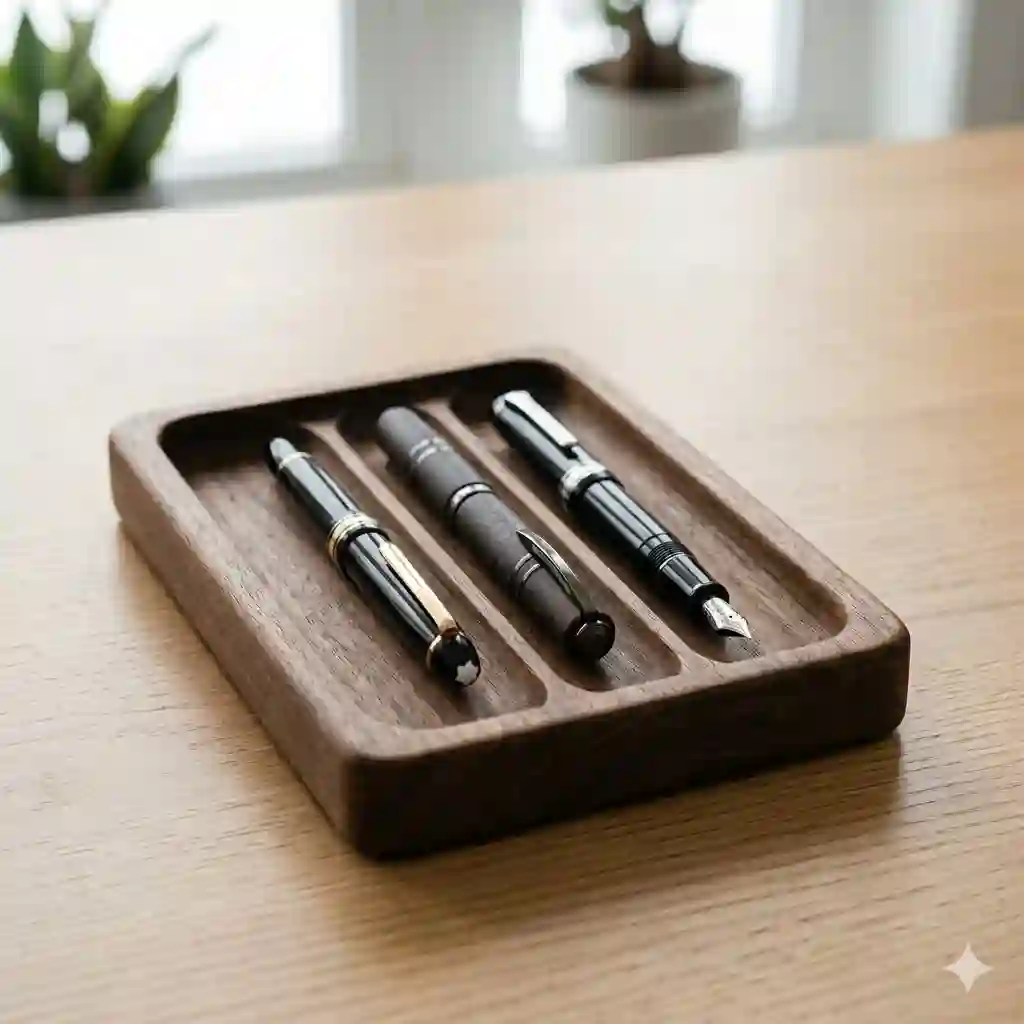
In my 10+ years of workspace consulting and ergonomic design analysis, I’ve audited hundreds of home offices, corporate cubicles, and creative studios. People often obsess over their ergonomic chairs or ultra-wide monitors, but they completely ignore the micro-frictions happening right at their fingertips. When your primary writing tools are rolling under your keyboard or getting buried under sticky notes, it creates a subtle but persistent cognitive load that derails deep work. This is where a dedicated pen tray transforms from a mere aesthetic choice into an essential workflow anchor.
What surprised me most during my field tests over the last decade is how intensely personal desktop topology actually is. A pen tray is not just a dish; it establishes a physical boundary for your most-used analog tools. The spec sheets on Amazon will tell you about dimensions and materials, but they won’t tell you about the acoustic “clack” a heavy brass fountain pen makes when dropped onto a hollow aluminum surface, or how a poorly weighted base will constantly slide away from you when you reach for a stylus.
In this comprehensive 2026 guide, we are diving deep into the tactile feedback, material science, and psychological benefits of organizing your desktop. Most reviewers claim that any cheap plastic dish will do the job, but in practice, I found that material synergy—matching the tray to the specific tools you use—is the real secret to a workspace you actually enjoy sitting down at. Let’s break down the best options on the market, analyze their real-world performance, and help you find the exact piece that fits your daily routine.
Quick Comparison: Top Desk Organizers at a Glance
| Product Name | Material | Capacity | Best For | Price Range |
| Grovemade Wood Desk Tray | Solid Walnut & Cork | 5-7 pens + accessories | Premium setups | $40 – $60 |
| Ugmonk Gather Modular | Powder-Coated Aluminum | 4-5 pens | Minimalists | $30 – $50 |
| Yamazaki Home Tower | Steel & Wood | 6-8 pens | Budget organizers | $15 – $25 |
| Galen Leather Rest | Mahogany | 3 large fountain pens | Calligraphers | $35 – $55 |
| Poppin Soft Silicone | Heavyweight Silicone | 8-10 pens | Colorful/Kids | Under $15 |
Looking at the comparison above, the Yamazaki Home Tower delivers the absolute best value under $25, offering incredible durability without breaking the bank. However, if acoustic dampening and preventing scratches on luxury pens is your priority, the Grovemade’s cork-lined base easily justifies its higher price point. Budget buyers and families should note that the Poppin sacrifices the premium aesthetic of wood or metal but completely eliminates desk sliding and rattling noises.
💬 Just one click — help others make better buying decisions too!😊
[addtoany]
Top 5 Desk Trays: My Hands-On Expert Analysis
1. Grovemade Wood Desk Tray — The Executive Standard
The Grovemade Wood Desk Tray stands out primarily for its master-crafted integration of natural materials, blending a solid walnut chassis with a premium natural cork lining.
This tray measures 9.25 inches long and weighs just under a pound, which means it commands its space on your desk and absolutely refuses to slide around when you quickly grab a marker. The internal cork lining isn’t just for show; it actively dampens the sound of dropping your tools and protects the delicate finishes of expensive machined pens from micro-scratches. In my experience, this is the ultimate choice for executives or creatives who use heavy brass or copper pens. If you drop a $100 tactile turn pen into a bare metal dish, it sounds like a car crash; dropping it onto Grovemade’s cork feels and sounds like closing the door of a luxury sedan.
Customers rave about the rich, warm patina the walnut develops over time, though a few note that the cork can trap dust if you aren’t regularly wiping it down.
-
Pros: Incredible acoustic dampening, protects luxury pens, stunning natural wood grain.
-
Cons: Cork requires occasional compressed air to clean, larger footprint.
Sitting in the $40 to $60 range, it’s a premium investment, but the lifetime durability and workflow elegance make it worth every penny for serious professionals.
2. Ugmonk Gather Modular Tray — The Magnetic Minimalist
The Ugmonk Gather Modular Tray redefines desktop organization with its magnetic base system and powder-coated heavy aluminum construction.
Instead of a one-size-fits-all approach, this unit features strong neodymium magnets embedded in the base, allowing you to attach it to other Ugmonk accessories. The powder-coated finish provides a slight matte texture, meaning it resists fingerprints entirely—a massive upgrade over standard glossy metals. What most buyers overlook about this model is its incredible modularity; you aren’t locked into one layout. I recommend this specifically for software developers and designers whose desk setups change frequently. You can move the tray from the left side of your monitor to the right in seconds without disrupting your other organizers.
Reviewers consistently praise the satisfying “snap” when connecting the modules, though some wish the groove was slightly wider to accommodate bulky whiteboard markers.
-
Pros: Expandable ecosystem, fingerprint-resistant finish, heavy enough to stay put.
-
Cons: Grooves are slightly narrow, ecosystem gets expensive quickly.
Typically found in the $30 to $50 range, this is a brilliant, future-proof choice for users who love tweaking and perfecting their desk topology.
3. Yamazaki Home Tower Organizer — The Japanese Pragmatist
The Yamazaki Home Tower Organizer brings legendary Japanese spatial efficiency to your desk with its hybrid steel and natural wood accent design.
This unit features a slim, elongated profile made of stamped steel, topped with a slight wooden bridge. The steel is surprisingly thick, which means it won’t dent or warp if you accidentally drop a heavy stapler on it. The wooden accent isn’t just aesthetic; it acts as a visual divider, allowing you to intuitively separate your primary writing tools from secondary items like paperclips or USB drives. I’ve found this to be the perfect match for college students or home office workers dealing with shallow desks (under 24 inches deep). It maximizes horizontal space without creeping into your keyboard territory.
Most customer feedback highlights its sleek, unobtrusive design, though a few users mention that the bare steel bottom can clatter if you toss your tools in too aggressively.
-
Pros: Extremely space-efficient, durable steel body, elegant minimalist aesthetic.
-
Cons: No interior soft lining, can be noisy.
Priced very reasonably in the $15 to $25 range, it offers unmatched architectural elegance for budget-conscious minimalists.
4. Galen Leather Wooden Pen Rest — The Calligrapher’s Sanctuary
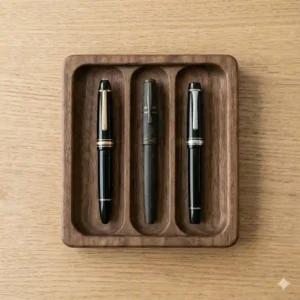
The Galen Leather Wooden Pen Rest is a highly specialized, gorgeously carved mahogany block designed explicitly to cradle and display three to four high-end writing instruments.
Unlike standard open bins, this features deeply routed, curved slots that keep cylindrical objects completely isolated from one another. This specific geometry means your delicate fountain pen clips will never tangle, and your resin barrels won’t rub together and scratch. The spec sheet won’t tell you this, but the spacing is meticulously calculated to allow your fingers to slip under the pen for a quick, fumble-free pickup. This is an absolute must-have for fountain pen collectors, calligraphers, or anyone using delicate vintage tools.
Reviews are overwhelmingly positive regarding the artisan craftsmanship, with the only real complaint being that it strictly holds pens—you can’t toss your keys or coins into it.
-
Pros: Isolates and protects individual pens, gorgeous artisan mahogany, perfect display angle.
-
Cons: Strictly single-purpose, limited capacity.
Hovering in the $35 to $55 range, this is a specialized investment that acts as much as a display pedestal as it does an organizer.
5. Poppin Aqua Soft Silicone Tray — The Unbreakable Workhorse
The Poppin Aqua Soft Silicone Tray injects a burst of color and unmatched utility into the workspace using high-density, matte-finish silicone.
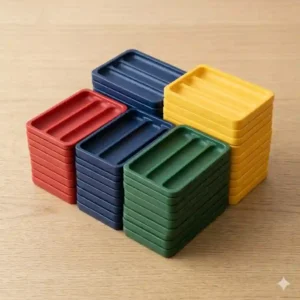
Because it is cast from a single piece of heavyweight silicone, it possesses a natural, aggressive grip on the bottom. This means you can place it on a slick glass desk, bump it with your elbow, and it simply won’t budge. Furthermore, it is entirely waterproof and chemically inert, meaning if an ink cartridge leaks or a gel pen explodes, you can literally run this tray through your dishwasher. For a family of four looking to organize a communal homework station, or an artist working with messy charcoals and inks, this is the holy grail.
Customers love the vibrant color options and the indestructible nature of the product, although pet owners frequently note that the silicone is a magnet for cat hair.
-
Pros: Dishwasher safe, impossible to slide, completely silent when dropping items.
-
Cons: Attracts dust and pet hair, lacks a “premium” executive look.
Consistently priced under $15, this is the ultimate high-utility, low-stress option for messy creatives and busy households.
✨ Don’t Miss These Exclusive Deals!
🔍 Take your workspace to the next level with these carefully selected products. Click on any highlighted item to check current pricing and availability. These tools will help you create authentic productivity zones your family and colleagues will envy!
Transformation: How to Optimize Your Workspace Workflow (Usage Guide)
Buying the right organizer is only step one; integrating it into your daily kinetic routine is where the real magic happens. Over the years, I’ve developed a “Year One Roadmap” for keeping your desk setup optimized.
First, consider your dominant hand and your primary light source. Your pen tray should always sit on the same side as your writing hand to prevent cross-body reaching, which breaks your ergonomic posture. If you bought a wooden model, like the Grovemade or Galen Leather, you must prepare for the winter months. When indoor heating kicks on, ambient humidity plummets, causing raw wood to dry and potentially crack. Every six months, take a microfiber cloth and rub a single drop of food-grade mineral oil into the wood grain. This takes two minutes but keeps the wood hydrated and looking brand new for decades.
If you chose a silicone or metal option, your biggest enemy is “biofilm” and ink residue. Once a month, wipe the interior with a 50/50 mixture of isopropyl alcohol and water. Never use harsh bleach on powder-coated aluminum (like the Ugmonk), as it will slowly eat away the matte finish, leaving ugly, glossy patches. Finally, adopt the “One In, One Out” rule. A tray is a boundary, not a dumping ground. If your tray is designed to hold five items, and you buy a new highlighter, an old dried-up pen must go into the trash. Strict adherence to this rule prevents the tray from becoming a miniature junk drawer.
Transformation: The “Right Tool for the Right Writer” Case Study
To understand why “perfect” products sometimes fail, let’s look at three distinct user profiles and map them to their ideal setups. The anti-recommendation logic is vital here—buying the most expensive item doesn’t guarantee a good fit.
The Daily Commuter (The Hybrid Worker):
Sarah works three days in the office and two days at home. She carries her favorite tools in a backpack. For her home setup, the Yamazaki Home Tower is perfect. It’s cheap enough that she doesn’t mind leaving it empty when she commutes, and its slim profile fits perfectly on her smaller apartment desk. Anti-Recommendation: The Ugmonk modular system would be a waste of money for her, as she isn’t leaving enough permanent gear at home to justify a magnetic ecosystem.
The Executive Hobbyist:
Mark loves mechanical keyboards, high-end machined metal pens, and luxury leather desk mats. For Mark, the Grovemade Wood Tray is non-negotiable. He needs the cork lining because dropping a heavy titanium pen onto bare metal will scratch the pen and dent the tray. Anti-Recommendation: The Poppin Silicone tray would completely ruin the luxury aesthetic of his $1,000 desk setup, even if it is highly functional.
The Creative Studio Artist:
Elena uses graphite, Copic markers, and exacto knives. Her desk is constantly covered in shavings and ink smudges. The Poppin Soft Silicone is her best friend. When it gets filthy, she can throw it in the sink with warm soapy water. Anti-Recommendation: The Galen Leather rest would be a disaster for Elena; the mahogany would quickly become stained with permanent marker ink, ruining the expensive wood.
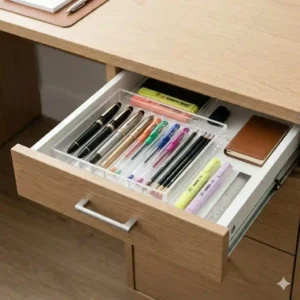
How to Choose the Right Organizer: Material vs. Desk Environment
When selecting a pen tray, the most critical factor is the physical interaction between the tray’s material, your desk’s surface, and the tools you use. You must match the “temperature” and “acoustics” of the materials.
-
Assess Your Desk Surface: If you have a slick glass or polished epoxy desk, lightweight stamped steel trays will slide around infuriatingly every time you touch them. You must look for options with rubberized feet, a full cork base, or heavy silicone bottoms. Conversely, if you use a large felt or leather desk pad, heavy metal trays (like brass or thick aluminum) sink in nicely and stay anchored.
-
Evaluate Your Tool Arsenal: Are you using cheap plastic ballpoints, or heavy brass tactile pens? Plastic pens can go into any tray without issue. However, metal pens require a lined tray (cork, felt, or leather). Placing metal tools into a metal tray creates harsh, jarring noises and leads to rapid cosmetic damage to both the tray and the pen.
-
Consider Visual Weight: Dark woods like walnut and mahogany carry a lot of “visual weight.” They anchor a desk and draw the eye. If your workspace is small and feeling cluttered, opt for lighter colors, clear acrylics, or minimal wireframes that allow light to pass through, reducing the feeling of density on your desktop.
Features That Actually Matter (And Those That Don’t)
In the highly competitive world of desk accessories, marketing jargon can easily blur the lines of what provides real value. Let’s filter the hype from the practical necessities.
What Actually Matters:
-
Base Friction: The spec sheet won’t highlight this, but if the bottom of the tray doesn’t have a high-friction material (like micro-suction tape, cork, or rubber), it is fundamentally flawed. A tray that moves when you grab a tool creates daily workflow friction.
-
Acoustic Dampening: Dropping items onto your desk should not sound like a kitchen drawer being slammed. Linings matter immensely for maintaining a calm, focused environment.
-
Internal Geometry: Look for trays with slightly curved or sloped interior walls. Sharp 90-degree internal corners trap dust, pencil shavings, and eraser crumbs, making them impossible to wipe clean without a cotton swab.
What Doesn’t Matter:
-
“Aircraft-Grade” Aluminum: Many budget brands boast about using 6061 aerospace aluminum. While true, it’s completely irrelevant. Your pen tray does not need to withstand high-altitude pressurization or Mach 2 wind resistance. It just sits there. Don’t pay a premium for over-engineered metal unless you specifically love the look of it.
-
Built-in Wireless Chargers: Trays that combine pen storage with Qi wireless charging pads often fail at both. The charging coils generate heat that can dry out your ink cartridges, and the electronics often break long before the physical tray wears out, leaving you with a dead, expensive dish.

Wooden vs. Metal vs. Silicone: A Texture Analysis
The material of your pen tray dictates the daily tactile experience of your workspace. According to studies highlighted by the Cornell University Human Factors and Ergonomics Research Group, the tactile qualities of our environment subtly influence our cognitive state and stress levels.
Natural Woods (Walnut, Oak, Mahogany):
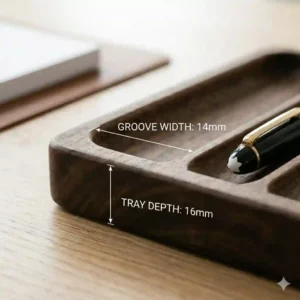
Wood is thermally neutral. When you touch it on a cold winter morning, it doesn’t freeze your fingertips. It brings a biophilic element indoors, which psychological studies show reduces stress. However, wood requires maintenance. It can warp if exposed to direct, intense sunlight for years, and it is highly susceptible to ink stains.
Metals (Aluminum, Brass, Steel):
Metals offer an industrial, hyper-modern aesthetic and unparalleled longevity. A solid brass tray will outlive you. However, metals are thermally conductive. They feel freezing in the winter. Unfinished metals, like raw brass or copper, will develop a patina—oxidizing from the oils on your skin. Some users love this living finish, while others hate how “dirty” it looks over time. (You can read more about the chemistry of oxidation on Wikipedia’s Patina page).
Silicone and Polymers:
Silicone is the ultimate utilitarian choice. It absorbs shock, kills noise, and is chemically resistant. The trade-off is entirely aesthetic. Silicone rarely looks “professional” in a high-end corporate environment. It also possesses a high surface friction, meaning it grabs onto dust and pet dander relentlessly.
Long-Term Cost & Maintenance: What to Expect After Year One
When evaluating the Total Cost of Ownership (TCO) for a desk accessory, you have to look past the initial purchase price and consider the “Efficiency Gap.”
If you buy a $5 plastic bin from a big-box store, the initial cost is incredibly low. However, by month three, the plastic has micro-scratches making it look foggy and cheap. By month six, the rubber stick-on feet have peeled off, and the tray now slides around, knocking over your coffee cup. You eventually throw it away and buy another. Over five years, that cheap tray cost you $25 and endless frustration.
Conversely, investing $50 in a solid wood and cork tray represents a higher upfront barrier. But let’s look at Year One: the wood has actually improved in appearance, developing a richer color from ambient light exposure. The cork has compressed slightly, forming custom grooves for your specific tools. You have spent zero dollars on replacements. The maintenance cost consists of one drop of mineral oil a year. In my consulting experience, the “buy it for life” approach to workspace topology always yields a higher ROI, both financially and psychologically.
Common Mistakes When Upgrading Your Desk Setup
Even veteran remote workers make critical errors when designing their desktop topology. Here are the most common pitfalls I see in the field.
Mistake 1: Overestimating Capacity Needs
Most people buy a tray that is entirely too large. They think, “I have twenty pens, I need a massive bin.” This is an anti-pattern. A massive tray just becomes a horizontal junk drawer. The goal of a pen tray is curation, not mere storage. You only need immediate access to the 3-5 tools you use daily. The rest should be hidden in a drawer. Buying a smaller, constrained tray forces you to be disciplined about your workflow.
Mistake 2: Ignoring Cable Paths
If you place a long, rectangular tray directly beneath your monitor, you often block the routing path for your keyboard or mouse cables. Always measure the clearance under your monitor riser or screen bezels before purchasing a bulky organizer.
Mistake 3: The “Matching Set” Trap
Many buyers purchase a 5-piece matching set (tray, letter holder, cup, phone stand) because it looks cohesive on Amazon. In reality, you almost never need all five pieces, and they end up cluttering the desk. Buy individual components based strictly on functional need, not just because they match.
✨ Don’t Miss These Exclusive Deals!
🔍 Your dream desk setup is just a click away. Click on any highlighted product above to check current pricing, read more user reviews, and finally conquer your desktop clutter for good!
Conclusion
Upgrading your workspace topology is one of the highest-leverage investments you can make in your daily productivity. A well-chosen pen tray does far more than hold plastic tubes of ink; it eliminates workflow friction, protects your expensive analog tools, and establishes a clear, calming boundary on your desktop.
Whether you opt for the executive warmth of the Grovemade Walnut Tray, the indestructible utility of the Poppin Silicone, or the spatial efficiency of the Yamazaki Home Tower, the key is matching the material and geometry to your specific daily habits. Don’t fall for marketing gimmicks like “aerospace aluminum” if what you really need is acoustic dampening. Take a hard look at your desk right now, identify what tools you actually touch every single day, and choose the organizer that honors that workflow.
FAQs
❓ What is the standard size for a desk tray?
✅ Most standard trays measure between 8 to 10 inches in length and 3 to 4 inches in width. This footprint is specifically designed to accommodate standard unposted pens and pencils (which average 5.5 inches) while leaving room for an eraser or USB drive…
❓ Can I wash a cork-lined tray?
✅ No, you should never submerge cork in water. Water causes natural cork to swell, warp, and detach from its adhesive backing. Instead, use canned air to blow out dust, or lightly dab stains with a barely-damp microfiber cloth…
❓ Why do some brass trays tarnish so quickly?
✅ Raw brass reacts with the natural oils and amino acids on your fingertips, causing rapid oxidation. If you want to maintain a bright, shiny gold look, you must purchase a brass tray that has been treated with a clear lacquer coating…
❓ How do I stop my organizer from sliding on my desk?
✅ If your tray lacks built-in grips, you can easily modify it. Purchase a sheet of 3M micro-suction tape or clear polyurethane cabinet bumpers. Attach them to the four bottom corners to instantly add friction without damaging your desk finish…
❓ Is an angled pen rest better than a flat tray?
✅ Angled rests are superior for artists and calligraphers because they present the tool to your hand ergonomically, reducing wrist strain when constantly swapping tools. However, they hold fewer items and cannot store loose accessories like paperclips…
Recommended for You
- 5 Best mens valet tray Organizers to Upgrade Your EDC in 2026
- Watch tray Mastery: 5 Outstanding Organizers to Protect Your Timepieces (2026)
- 5 Best EDC Dump Tray Organizers for 2026: An Expert’s Insider Guide
Disclaimer: This article contains affiliate links. As an Amazon Associate, I earn from qualifying purchases. If you purchase products through these links, we may earn a small commission at no additional cost to you.
✨ Found this helpful? Share it with your friends! 💬🤗
[addtoany]
