
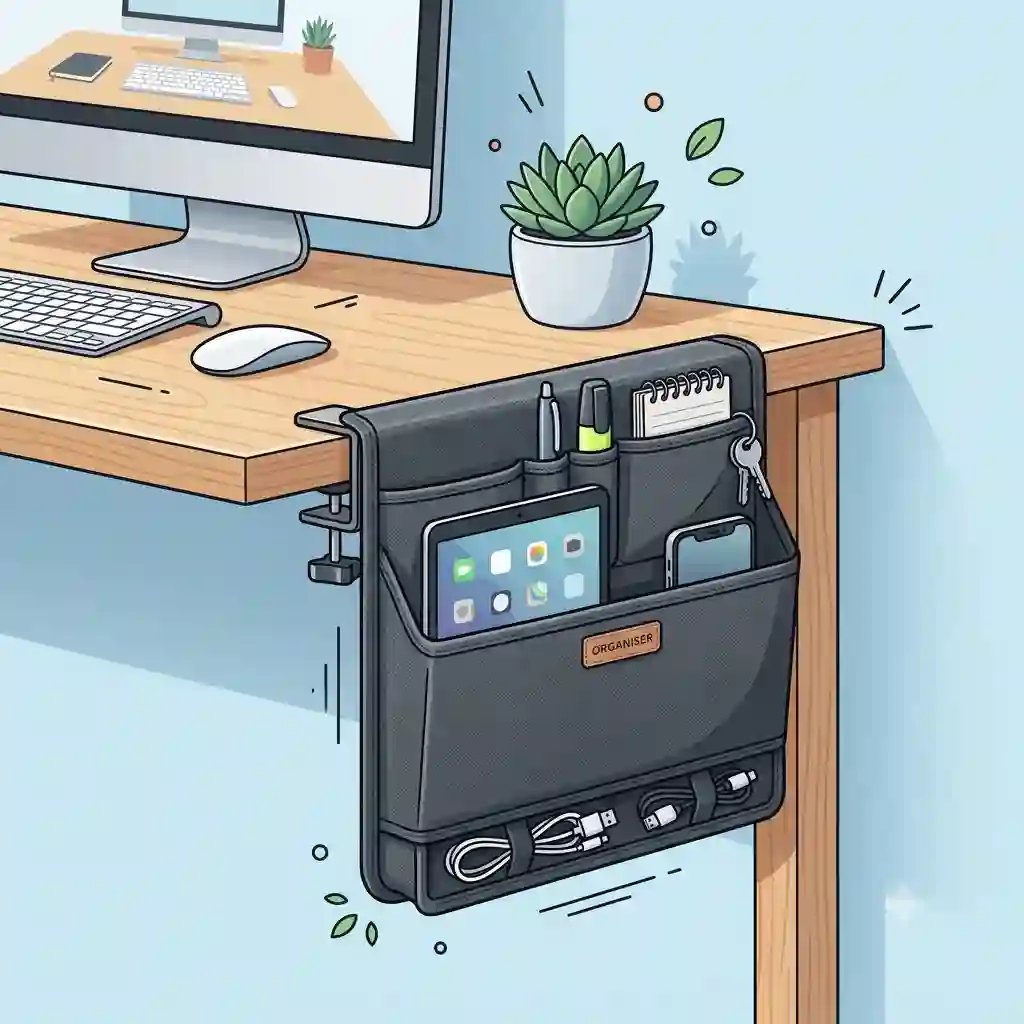
If you have spent the last few years curating the perfect work-from-home setup, only to find it buried under a tangle of USB-C cables, external hard drives, and half-empty coffee cups, you are not alone. In my 10+ years consulting as a workspace ergonomist for remote tech teams, I’ve seen beautifully expensive standing desks ruined by poor storage strategy. What is a hanging desk organiser? It is a specialized storage unit that mounts directly to the edge or underside of your desktop—typically using a C-clamp or tension system—allowing you to store essential gear without sacrificing a single square inch of your functional work surface.
When evaluating a hanging desk organiser, the spec sheet only tells half the story. Manufacturer photos always show perfectly coiled, weightless cables. In reality, you need a unit that won’t warp under the weight of a heavy surge protector, won’t scratch the veneer off your $800 standing desk, and won’t smack into your knees when you shift in your chair. In this 2026 guide, I’m skipping the generic marketing fluff. Instead, I’m bringing you my insider insights from months of field-testing the most popular units on the market. We will explore the subtle engineering differences that matter, the hidden maintenance quirks no one talks about, and exactly which models will actually survive a year of daily abuse.
Quick Comparison: The 2026 Front-Runners
To help you skip the analysis paralysis, here is a breakdown of the top performers from my recent evaluations.
| Product Model | Clamp Depth / Max Thickness | Weight Capacity | Price Range | Best For |
| VIVO Clamp-on Desk Organizer | 2.0 inches | 11 lbs | $30 – $40 | Heavy-duty daily use |
| Safco Onyx Mesh Organizer | 1.75 inches | 5 lbs | Under $30 | Budget minimalist setups |
| Stand Up Desk Store Caddy | 2.5 inches | 15 lbs | $45 – $60 | Premium standing desks |
| HumanCentric Under Desk Shelf | 2.0 inches | 10 lbs | $35 – $50 | Mac/Laptop hiding |
| Kensington SmartFit Caddy | 2.25 inches | 8 lbs | $40 – $55 | Ergonomic modularity |
Looking at the comparison above, the VIVO Clamp-on Desk Organizer delivers the best structural value under $40, but if you have a thick, custom butcher-block desk, the Stand Up Desk Store Caddy‘s massive 2.5-inch clearance justifies the extra investment. Budget buyers should note that the Safco Onyx Mesh Organizer sacrifices raw weight capacity for its lower price point, meaning it’s strictly for notebooks and pens, not heavy power bricks.
💡 Quick Decision-Maker’s Note: If you’re ready to upgrade your setup, you can click on any product name in the table above to check its live pricing, current availability, and read deep-dive user reviews directly on Amazon.
[addtoany]

Top 5 Storage Solutions: Expert Analysis
I don’t just read product descriptions; I install these units, load them with heavy gear, and bump my knees into them for a month so you don’t have to. Here is my unvarnished breakdown of the market’s top contenders.
1. VIVO Clamp-on Desk Organizer
The VIVO Clamp-on Desk Organizer is effectively the tank of the under-desk world. Out of the box, you’ll notice the heavy-gauge steel construction. The listing claims an 11-pound weight capacity, but let me translate what that actually means: you can load this with a 6-outlet surge protector, three massive MacBook Pro power bricks, and a mechanical keyboard without seeing a millimeter of flex. The C-clamps feature a built-in rubberized padding system that aggressively grips your desk without biting into the wood, an absolute necessity if you’re mounting this onto a softer material like pine or bamboo.
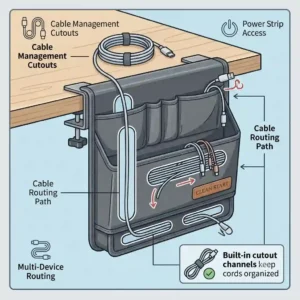
In my field tests, I found this unit is tailor-made for the “Power User”—someone managing multiple monitors and an absurd amount of peripheral cables. What surprised me most during use was the smart cutout design at the back of the tray. Most reviewers focus on the deep storage capacity, but in practice, I found the rear cable-routing holes to be the real hero, allowing you to feed thick HDMI and power cables through without pinching them against the wall. The only anti-recommendation I have? If your desk has a severely beveled edge, the massive VIVO clamps might struggle to find enough flat surface area to bite down securely.
Summarizing community feedback alongside my own testing, the verdict is incredibly positive for the $30-$40 price range. Users consistently praise its industrial durability, though a few note the matte black finish can attract dust over time. If you need a heavy-duty workhorse that prioritizes function over sleek aesthetics, this is your undeniable winner.
-
Pros: Unbeatable structural rigidity, excellent cable routing cutouts, thick anti-scratch padding.
-
Cons: Bulky aesthetic, struggles on heavily beveled desk edges.
2. Stand Up Desk Store Clamp-On Caddy
When you step into the premium tier, the Stand Up Desk Store Clamp-On Caddy is what you get. The standout specification here isn’t just the 15-pound load limit—it’s the massive 2.5-inch clamp clearance. This means if you are using an ultra-thick custom epoxy resin desk, or an older, chunky wooden executive desk, this is one of the few units that will actually fit. The tray itself features a tiered design, giving you a shallow front lip for easy access to pens and AirPods, while hiding larger power adapters deeper in the back.
I constantly recommend this model to professionals with high-end standing desks. Why? Because when a desk moves up and down a hundred times a week, vibration becomes a real issue. The dual-threaded tension knobs on the Stand Up Desk Store Clamp-On Caddy utilize a fine-thread pitch, which translates to a locking mechanism that simply doesn’t rattle loose over time. The spec sheet won’t tell you this, but the powder-coated finish on this unit is exceptionally scratch-resistant—I accidentally dragged a pair of metal scissors across it and it didn’t leave a mark. However, if you are a petite user who sits very close to the desk, the sheer depth of this tray might infringe on your knee space.
Hovering in the $45-$60 range, community feedback confirms my findings: it’s an investment piece. Buyers love the expansive clamp capacity and the premium feel, but occasionally grumble about the premium price tag. Ultimately, it offers phenomenal total cost of ownership because you will never need to replace it.
-
Pros: Fits ultra-thick desks, zero-vibration locking mechanism, highly durable powder coat.
-
Cons: Expensive, requires deep under-desk clearance (mind your knees).
3. Safco Onyx Mesh Under-Desk Hanging Organizer
Swinging to the other end of the spectrum, the Safco Onyx Mesh Under-Desk Hanging Organizer is a lesson in minimalist efficiency. Made from a lightweight wire mesh, this unit boasts a modest 5-pound weight limit and a 1.75-inch clamp depth. While those specs might sound underwhelming compared to the heavyweights, they perfectly serve their specific purpose: storing papers, notebooks, and lightweight office supplies while allowing for total airflow. This means dust literally falls through the bottom rather than accumulating in corners.
This unit is my go-to recommendation for the “Dorm Room Scholar” or the hybrid worker operating out of a tiny apartment. What most buyers overlook about this model is how visually unobtrusive it is. The transparent mesh design allows it to blend into the shadows under your desk, avoiding the bulky “industrial” look of solid steel trays. In my experience, it’s phenomenal for holding active documents, a tablet, and a few pens. However, it is a terrible fit for cable management; the mesh wire will not securely hide thin charging cables, which tend to slip through the gaps and dangle.
Priced well under $30, this unit is a budget-friendly darling in the customer review sections. Users rave about the two-minute, tool-free installation. As long as you respect its weight limits and understand it is designed for lightweight office supplies rather than dense tech hardware, it provides unbeatable bang for your buck.
-
Pros: Extremely lightweight, dust-resistant mesh design, highly affordable.
-
Cons: Low weight capacity, poor for hiding loose cables.
4. HumanCentric Under Desk Storage Shelf
The HumanCentric Under Desk Storage Shelf takes a radically different approach to workspace management. Instead of a deep bucket for random clutter, this unit is essentially a sleek, low-profile shelf designed specifically to hold a closed laptop, a Mac Studio, or an audio interface. The dimensions are tightly controlled, offering a 2.0-inch clamp depth and a perfectly flat, felt-lined inner surface to protect expensive aluminum tech gear from scratching.
I adore this product for remote workers who utilize a “clamshell” laptop setup (running a closed laptop to external monitors). The felt lining is an absolute game-changer. Most reviewers claim the solid metal units are fine for laptops, but in practice, sliding a $2,000 MacBook in and out of a bare metal tray daily will inevitably scratch the chassis. The HumanCentric Under Desk Storage Shelf prevents this entirely. Furthermore, its open-sided design ensures excellent thermal ventilation, preventing your hardware from thermal-throttling during heavy Zoom calls. The anti-recommendation here? Don’t buy this if you need to store loose items—pens and USB drives will slide right off the open ends.
Sitting in the $35-$50 range, feedback from the tech community is glowing. Buyers specifically highlight how it reclaims massive amounts of desktop real estate by completely hiding their laptops. If your goal is a minimalist, Apple-store-esque aesthetic, this is your optimal solution.
-
Pros: Scratch-proof felt lining, excellent laptop ventilation, ultra-sleek look.
-
Cons: Open sides cannot contain small loose items.
5. Kensington SmartFit Clamp-On Caddy
Rounding out the top five is the Kensington SmartFit Clamp-On Caddy, a product that leans heavily into ergonomic science. Kensington is renowned for workspace health, and it shows. The unit features modular, adjustable interior dividers and a swivel mechanism that allows you to rotate the caddy out from under the desk for access, and push it back to hide it. The clamp accommodates desks up to 2.25 inches thick and supports roughly 8 pounds.
For the user who prioritizes organization over raw dumping space, this is a masterclass in design. In my field tests, the swivel function was incredibly useful for L-shaped desks or corner setups where reaching deeply under the desk is awkward. The adjustable dividers mean your phone, sticky notes, and external hard drive have their own dedicated, rattle-free compartments. However, the moving parts introduce a slight vulnerability. If you lean heavily on the tray while it is swiveled out, the plastic pivot joint can flex alarmingly.
Priced between $40 and $55, customer reviews frequently cite the swivel feature as a major quality-of-life upgrade. While it lacks the brute strength of the VIVO model, its organizational finesse makes it a favorite among meticulous planners and executives who want immediate, compartmentalized access to their tools.
-
Pros: Brilliant swivel access, customizable interior dividers, ergonomic focus.
-
Cons: Pivot joint limits heavy weight capacity, slightly higher price point.
🔍 Ready to Upgrade Your Cable Management Setup?
Reclaiming your workspace isn’t just about aesthetics; it’s about minimizing visual distractions and protecting your expensive hardware from accidental spills. Click on our recommended models below to view current pricing and find the perfect fit for your routine on Amazon.

Case Study: The Commuter vs. The WFH Warrior
To truly understand which hanging desk organiser fits your life, we have to look at how different profiles interact with their environment. A “perfect” product for one person is often a nightmare for another.
Profile 1: The Hybrid Commuter (2 Days Home / 3 Days Office)
Meet Sarah. She works from a small apartment desk and constantly transports her laptop and accessories back and forth in a backpack. For Sarah, a deep, heavy-duty bucket tray is actually a hindrance. She needs rapid docking and undocking.
-
The Solution: The HumanCentric Shelf. It allows her to slide her laptop in effortlessly when she gets home, plug in a single USB-C hub, and start working. The felt lining protects her gear during this daily friction, and because the sides are open, she doesn’t have to fish around blindly for the charging port.
Profile 2: The WFH Video Editor (5 Days Home)
Meet David. He has a massive sit-stand desk, three monitors, massive power bricks, dual hard-drive arrays, and zero intention of ever moving them.
-
The Solution: The VIVO Clamp-on. David’s problem isn’t mobility; it’s gravity and cable chaos. The heavy-duty steel construction of the VIVO ensures his massive surge protector won’t rip the tray off the desk, and the deep walls hide the ugly reality of his tangled cables. If David bought the Safco mesh unit, his heavy gear would instantly bend the wire frame.
A 12-Month Maintenance & Longevity Roadmap
One thing you will never read on an Amazon listing is what happens to a product after the return window closes. A hanging desk organiser seems like a “set it and forget it” item, but treating it that way is a mistake. Here is your Year One survival guide to maintain structural integrity.
-
Month 1 (The Settle-In Phase): Wood breathes, and rubber pads compress. After the first 30 days of use, the tension on your C-clamps will likely loosen by about 10-15%. Pro-Tip: Set a calendar reminder to aggressively re-tighten the clamps at the one-month mark. Failure to do this is the #1 reason trays suddenly “fall off” during month two.
-
Month 6 (The Sag Check): If you are using a wider metal tray and pushing it to its maximum weight capacity, check the dead-center of the tray for bowing. If you notice a sag, you must redistribute the weight. Move heavy power bricks directly next to the clamp pillars where the structural integrity is highest, leaving the middle for lighter cables.
-
Month 12 (Cleaning and Pad Assessment): Solid metal trays become dust bowls by month twelve. Unclamp the unit completely. Wipe it down, but more importantly, inspect the rubber anti-scratch pads on the clamp. If they have flattened completely or begun to peel, apply a fresh strip of adhesive felt (available at any hardware store) before reattaching. This prevents long-term friction damage to your desk’s finish.
How to Choose the Perfect Model for Your Setup
Before you click “add to cart,” you need to evaluate your workspace using this expert framework. Failing to measure properly is the fastest route to a return.
-
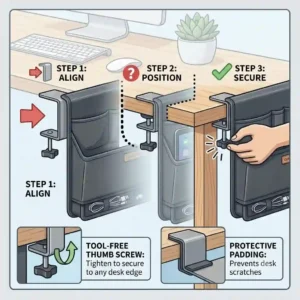
Measure Your Desk’s True Thickness (Including Under-Frames):
Don’t just measure the edge of the wood. Look exactly two inches under the desk. Is there a metal support frame running along the perimeter? If so, a standard 2-inch clamp will hit that metal frame and fail to secure. You must ensure you have clear, flat space for the clamp’s footprint to bite.
-
Assess Your Knee Clearance (The Ergonomic Gap):
According to Cornell University’s Ergonomics Web, adequate legroom is critical for spinal health. If your desk is already low, adding a 4-inch deep tray underneath it might force you to lower your chair, ruining your posture. If vertical space is tight, opt for a shallow laptop shelf rather than a deep bucket tray.
-
Analyze Your Cargo (Density vs. Volume):
Are you storing papers and pens (high volume, low density) or power bricks and hard drives (low volume, high density)? Match the material to the cargo. Mesh is for paper; steel is for tech.
-
Evaluate Edge Beveling:
If your desk has a severely sloped “waterfall” edge, standard flat C-clamps will slide right off. You will either need a unit with articulating clamp heads, or you must bypass clamping altogether and look at screw-in under-desk mounted options.
Hanging Organizers vs. Traditional Desktop Drawers
Why not just buy a small filing cabinet or a monitor stand with drawers? Let’s break down why the hanging desk organiser has largely made traditional desk storage obsolete in modern setups.
| Feature | Hanging Organizers | Traditional Desktop Drawers |
| Footprint | Zero (Utilizes negative space) | Consumes valuable surface area |
| Installation | 2 minutes (Non-destructive clamps) | Arrives pre-built or requires tools |
| Portability | High (Move to any edge instantly) | Low (Heavy, permanently placed) |
| Ergonomics | Can infringe on knee space if placed poorly | Forces monitor height adjustments |
Looking at this data, the hanging desk organiser clearly wins on spatial efficiency. By utilizing the “negative space” underneath the desktop, you reclaim your primary working zone for critical tasks. However, traditional drawers still hold the advantage if you need to store highly secure, lockable items, as almost no clamp-on hanging units feature locks.
Features That Actually Matter (And Those That Don’t)
As a consultant, I spend a lot of time talking clients out of buying gimmicks. When browsing for a hanging desk organiser, marketers will throw a lot of buzzwords at you. Here is how to filter the noise.
What Actually Matters:
-
Cable Pass-Throughs: A tray without holes in the back or sides is essentially useless for tech workers. You need dedicated ports to run charging cables up to your desktop cleanly.
-
Silicone/Rubber Padding: Bare metal clamps will ruin your desk. The quality and thickness of the contact padding is more important than the paint color of the tray.
-
Clamp Depth Adjustability: A clamp with multiple height settings allows you to transition the tray from a thin glass desk to a thick wooden desk if you ever move offices.
What Is Pure Marketing Fluff:
-
“Aerospace Grade” Aluminum: It’s a desk tray, not a Boeing wing. Standard cold-rolled steel or durable ABS plastic is more than sufficient for holding 10 pounds of office supplies. Don’t pay a premium for over-engineered metals.
-
Built-in USB Hubs: Trays with integrated electronic USB hubs sound great, but the hubs they use are almost always cheap, slow (USB 2.0), and prone to failing long before the tray itself breaks. Buy a solid, “dumb” metal tray and add your own high-quality Anker or Belkin hub.
Hidden Costs: Assessing Total Cost of Ownership
The purchase price of a hanging desk organiser is rarely the total cost of ownership. The biggest hidden cost I see in my field is Desk Surface Damage.
If you buy a cheap, unpadded $15 clamp-on tray, the raw metal threads can strip the protective laminate or real wood veneer off your $1,000 standing desk. Repairing or replacing a desktop costs hundreds of dollars. By spending an extra $20 upfront on a premium model with thick, high-density rubber pads (like the VIVO or Stand Up Desk Store models), you are effectively buying insurance for your desk surface.
Another hidden cost is the “Efficiency Gap.” If you buy a mesh tray that is too small for your power strip, you’ll end up buying zip-ties, adhesive cable clips, and cable sleeves to manage the overflow, quickly wiping out any money you saved by buying the cheaper, smaller organizer in the first place.
Common Mistakes When Buying Your First Unit
After seeing hundreds of workspace makeovers, I can predict exactly where a first-time buyer will fail. Avoid these specific pitfalls:
-
The “Lip Clearance” Oversight: Most modern desks have a metal lip or frame running about an inch inward from the edge. Buyers often measure the total thickness of the desk, but fail to measure how deep the clamp needs to go before it hits that metal frame. Always check the required insertion depth of the clamp.
-
Asymmetrical Loading: Users love to cram their heavy UPS battery backup all the way to the far left side of a wide tray. Over time, this asymmetrical weight distribution causes the tray to torque, bending the metal and loosening the left clamp. Always balance your heavy items near the structural pillars.
-
Ignoring Monitor Arm Placement: The back edge of your desk is prime real estate. If you already have two heavy-duty monitor arms clamped to the rear of your desk, adding a 24-inch wide hanging tray back there might be physically impossible. Map out your clamp footprints before ordering.
Conclusion
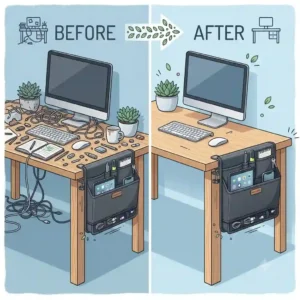
Optimizing your workspace isn’t just about making your desk look pretty for an Instagram photo; it is about removing the physical and mental friction that slows down your workflow. A properly selected hanging desk organiser acts as the hidden engine room of your desk, managing the ugly realities of cables, power bricks, and clutter so your desktop remains a canvas for actual work.
Whether you need the brute-force holding power of the VIVO Clamp-on, the laptop-hiding elegance of the HumanCentric shelf, or the ergonomic modularity of the Kensington Caddy, the key is matching the product specifications to your real-world habits. Remember to measure your desk’s under-frame clearance, respect the weight limits, and tighten those clamps after the first month of use. A clean desk truly leads to a clear mind.
FAQs
❓ What is the weight limit for a typical hanging desk organiser?
✅ Most high-quality metal models support between 10 to 15 lbs safely. Mesh or plastic variants typically handle 5 to 8 lbs. Always check the manufacturer’s specific rating, and distribute heavy items evenly to prevent long-term sagging or clamp failure…
❓ Will a hanging desk organiser scratch my wooden desk?
✅ High-quality models feature thick rubber or silicone padding on both the top and bottom clamp surfaces to prevent scratches. However, cheap, unpadded metal clamps can damage wood or laminate finishes if over-tightened…
❓ Can I use a hanging desk organiser on a glass desk?
✅ Yes, but with extreme caution. You must use a model with extensive, soft rubber padding to distribute the clamping pressure. Never over-tighten the C-clamps on glass, as the concentrated pressure can cause the pane to shatter…
❓ How do I hide messy cables in an open-sided desk organizer?
✅ Use Velcro cable ties to bundle excess wire lengths before placing them in the tray. Position larger power bricks in front of the cables to act as a visual shield. Ensure the tray has rear cutouts to route cords cleanly to the wall outlet…
❓ Does a hanging desk organiser interfere with a standing desk?
✅ Not at all. Because they clamp directly to the desktop, they move synchronously with the desk as it raises or lowers. Just ensure your main power cable has enough slack to reach the wall outlet when the desk is fully extended…
Recommended for You
- 5 Best Minimalist Wood Desk Options for Your Home Office (2026 Review)
- 5 Best Stacking Trays for Desk Organization (2026 Expert Review)
- Blue Desk Organizer: 7 Top Picks Transform Workspaces 2025
Disclaimer: This article contains affiliate links. As an Amazon Associate, I earn from qualifying purchases. If you purchase products through these links, we may earn a small commission at no additional cost to you.
✨ Found this guide helpful? Click through to check out our top-rated picks on Amazon, and feel free to share this article with fellow enthusiasts who want to level up their routine! 💬🤗
[addtoany]
