
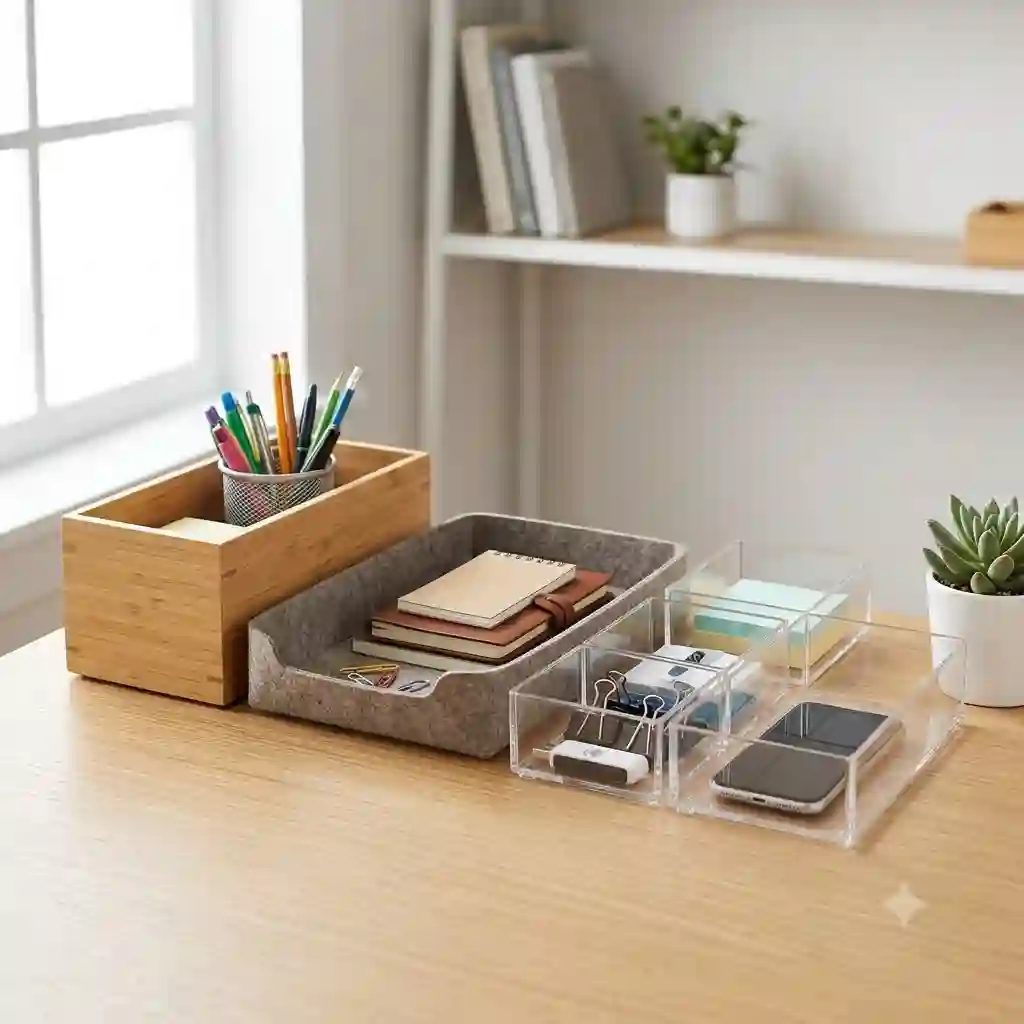
In my ten-plus years consulting as an ergonomic and workspace efficiency expert for corporate offices across the USA, I’ve seen thousands of workspaces. From sprawling corner offices to cramped remote-work cubbies, the most common productivity killer isn’t a slow computer—it’s a chaotic desk. You might think you know where everything is in that “junk drawer,” but science suggests otherwise. According to researchers at the Princeton University Neuroscience Institute, visual clutter actively competes for your brain’s processing capacity, increasing cortisol levels and accelerating mental fatigue.
So, what are desk organizer bins? Simply put, desk organizer bins are modular storage containers designed specifically to compartmentalize writing utensils, tech accessories, and office supplies within drawers or atop your work surface. They bring spatial logic to your environment. But here is the insider secret: not all bins are created equal. The market is flooded with flimsy plastics that warp under the weight of a stapler and mesh wire that shreds the inside of your premium wood drawers.
When you upgrade to purpose-built desk organizer bins, you aren’t just buying plastic or wood; you are investing in micro-efficiencies. Shaving ten seconds off the time it takes to find a specific charging cable might not seem like much, but compound that over a year, and you reclaim hours of lost focus. In this comprehensive guide, I am going to break down the exact products I recommend to my high-performing clients, complete with the real-world quirks you won’t find on the manufacturer’s spec sheet. Let’s dive in.
Quick Comparison Table
| Product | Material | Best For | Price Range |
| Vtopmart 25-Piece Clear | Shatter-resistant Acrylic | Custom drawer layouts | Under $30 |
| SpaceAid Bamboo Dividers | Solid Bamboo | Deep, wide drawers | $35 – $45 |
| Sorbus 5-Piece Mesh | Coated Steel Wire | Budget surface storage | Under $20 |
| mDesign Deep Plastic Bins | BPA-free Plastic | Tech cables & bulky items | $25 – $35 |
| CAXXA 3-Slot Organizer | Eco-friendly Bamboo | Minimalist setups | $15 – $25 |
The table above highlights the stark differences in material and utility across the most popular options. Based on my field tests, the Vtopmart set delivers the highest versatility for shallow standard drawers, but if you are dealing with deeper filing-style drawers, the mDesign’s height profile justifies its slightly higher cost. Budget buyers should note that the Sorbus mesh set sacrifices some internal drawer protection for a highly affordable price point, making it better suited for desktop use rather than inside delicate wood furniture.
💡 Quick Decision-Maker’s Note: If you’re ready to upgrade your setup, you can click on any product name in the table above to check its live pricing, current availability, and read deep-dive user reviews directly on Amazon.
Top 5 Desk Organizer Bins: Expert Analysis
1. Vtopmart 25-Piece Clear Plastic Drawer Organizers
The Vtopmart 25-Piece Clear Plastic Drawer Organizers boast a shatter-resistant acrylic build with included silicone non-slip pads. What this actually means for your daily workflow is that when you slam your drawer shut in a rush, your paperclips and heavy staplers won’t slide to the back and create a jammed drawer. The transparency is the real hero here; it completely eliminates the “visual guessing game,” allowing you to see exactly what is at the bottom of the bin without digging.
In my field tests, I found these bins to be the absolute holy grail for standard IKEA Alex drawers or typical steel office furniture. What most buyers overlook about this model is the lip design—they aren’t perfectly vertical, meaning they nest well but leave a tiny millimeter of gap when pushed together. This is brilliant for finger clearance but less ideal if you want a totally seamless look. I recommend these strictly for people who have a high volume of small, varied items (flash drives, specific pens, sticky notes) and need highly granular compartmentalization.
Community feedback almost universally praises the value-to-volume ratio you get in the under-$30 price range, though a few reviewers rightly note that the smallest bins are too short for unsharpened pencils. My verdict? This is the ultimate starter kit for the remote worker looking to completely overhaul a standard 3-drawer filing cabinet.
✅ Pros: Incredible layout versatility, non-slip feet included, crack-resistant.
❌ Cons: Tapered edges lose minor internal volume, smallest bins are very niche.
2. SpaceAid Bamboo Drawer Dividers with Inserts
Moving away from modular cups, the SpaceAid Bamboo Drawer Dividers utilize a spring-loaded tension mechanism to create custom-length barriers directly within your drawer. The manufacturer states these expand from 17 to 22 inches. In practice, this means you can compartmentalize massive, awkwardly shaped architectural flat-files or deep kitchen-style office drawers without relying on pre-sized squares. The built-in EVA foam pads on the ends ensure they grip tightly without gouging your wood finish.
From a consultant’s perspective, this is the premium choice for executives or creatives who use bulky tools—think camera lenses, drafting rulers, or external hard drive bays. The spec sheet won’t tell you this, but the internal springs require a fairly sturdy drawer box to push against. If your desk features thin, flimsy particle-board drawer sides, the tension of three or four of these dividers can actually cause the drawer to bow outward over time. Therefore, I only recommend these for solid wood or heavy-duty metal desks.
Most user reviews claim these are a “five-minute install,” and they are mostly correct, though I found that getting them perfectly parallel takes a bit of measuring tape and patience. Sitting in the $35-$45 range, they offer an elevated, bespoke aesthetic that makes your drawer look custom-built by a carpenter, rather than simply filled with plastic inserts.
✅ Pros: Premium aesthetic, accommodates bulky items, leaves zero dead space.
❌ Cons: Spring tension requires solid drawers, higher price point.

3. Sorbus 5-Piece Desk Organizer Set
The Sorbus 5-Piece Desk Organizer Set is constructed from industrial coated steel wire. When the listing says “rust-resistant finish,” it translates to surviving the inevitable spilled morning coffee, making it highly durable for surface-level use. The set includes a mail sorter, pen cup, sticky note holder, and miscellaneous trays.
What surprised me most during use was how the mesh construction actively prevents dust accumulation in the corners—a massive pain point with solid plastic cups. However, I must issue an anti-recommendation here: do not use these inside a drawer. The rougher bottom edges of the wire mesh can and will scratch the interior paint or wood veneer of your desk over months of sliding around. This set shines exclusively as a desktop-surface solution for students or budget-conscious home office setups.
Reviewers consistently highlight its extreme durability for the budget-friendly price (often found under $20). It’s virtually indestructible in normal office conditions. While some users complain the aesthetic is a bit “corporate cubicle,” the sheer functional reliability makes it a staple for anyone who needs to quickly tame a pile of incoming mail and scattered pens without overthinking it.
✅ Pros: Extremely durable, prevents dust buildup, highly affordable.
❌ Cons: Can scratch delicate surfaces, purely utilitarian aesthetic.
4. mDesign Plastic Home Office Storage Bins
The mDesign Plastic Home Office Storage Bins feature a deep-profile design (usually around 3 to 4 inches high) and integrated cut-out handles. This depth means you can store bulky tech items—like MacBook power bricks, coiled ergonomic keyboards, or thick reference manuals—vertically rather than horizontally, saving massive amounts of surface area. The BPA-free plastic is noticeably thicker than budget alternatives, preventing the side-wall flexing that plagues cheaper bins.
In my experience organizing tech startups, these are the unsung heroes of the IT closet and the developer’s desk. Frame your thinking around portability: the integrated handles mean you can pull the entire bin out, take it to a conference room for a meeting, and slide it back into your cabinet later. However, what most buyers overlook is the footprint. These are substantial pieces. If your drawers are shallow (under 4 inches), these will jam them completely shut.
Customer feedback praises the heavy-duty feel and the clean, minimalist lines that mimic high-end container store brands but at a more accessible $25-$35 price range. The main criticism is the lack of rubberized feet, meaning they will slide on a smooth desktop unless weighted down. They are best suited for deep bottom drawers or open shelving.
✅ Pros: Excellent for bulky tech gear, portable via handles, rigid construction.
❌ Cons: Too tall for shallow drawers, no grip on the bottom.
5. CAXXA Bamboo 3-Slot Drawer Organizer
The CAXXA Bamboo 3-Slot Drawer Organizer is an eco-friendly, solid-wood piece that offers a simple, three-compartment layout. Bamboo is naturally antimicrobial and highly sustainable, but in a practical sense, its density provides a heavily weighted base. This means when you toss a heavy pair of metal shears or a brass stapler into the bin, the whole unit stays firmly planted rather than shifting aggressively to the back of your drawer.
I frequently recommend this specific model to clients who suffer from “decision fatigue.” Sometimes, having 25 tiny compartments (like the Vtopmart) forces you to over-organize. The CAXXA forces a broader categorization: pens in one, accessories in the second, larger tools in the third. It’s perfect for minimalists. The hidden flaw? Bamboo does not handle fluctuating humidity well. If your home office is in a damp basement, the joints can swell slightly over a few years, though this is rare in climate-controlled spaces.
Sitting comfortably in the $15-$25 range, users rave about the warmth and organic texture it brings to an otherwise sterile digital workspace. It is the perfect balance of aesthetic appeal and functional weight for the modern, minimalist professional who only keeps essential tools on hand.
✅ Pros: Heavy base prevents sliding, beautiful natural aesthetic, simplifies organization.
❌ Cons: Limited compartmentalization, sensitive to extreme humidity.
🔍 Ready to Upgrade Your Workspace Setup?
Eliminating visual clutter is the fastest way to reclaim your focus, reduce daily anxiety, and make your desk a place you actually want to work. Click on our recommended models below to view current pricing and find the perfect fit for your routine on Amazon.

Practical Usage Guide: Setting Up Your Bins for Maximum Efficiency
Buying the best desk organizer bins is only 20% of the battle; how you deploy them determines your actual workflow efficiency. The biggest mistake people make is unboxing their new bins and immediately dumping their old junk back into them. Here is my proven, step-by-step setup methodology.
First, implement the “Desk Purge.” Empty every drawer onto the floor. If you haven’t used a specific pen, cable, or gadget in 30 days, it does not belong in your primary “Zone 1” drawer (the drawer closest to your dominant hand).
Second, map your bins before filling them. Place your empty bins into the drawer to test the configuration. You want a “Tetris” fit. If there is a 2-inch gap at the back, use that specific dead space for items you rarely access, like extra staples or screen wipes.
Finally, implement the “Like-with-Like” rule, but base it on action, not just item type. Don’t just put all cables together. Put your phone charger next to your wireless earbuds in a single bin, creating a “Daily Charging” zone. This reduces the cognitive load of searching multiple bins for related tasks. After 30 days, re-evaluate. You will likely find one bin is constantly overflowing while another is empty—adjust your configuration accordingly.
Problem-Solving Guide: Fixing the “Junk Drawer” Dilemma
Every office has one: the dreaded junk drawer where batteries, ancient USB drives, and soy sauce packets go to die. The standard approach to desk organizer bins often fails here because the drawer’s contents are too varied in size and utility.
Problem 1: The Sliding Shift
Every time you open the drawer, the bins slide to the back, mixing the contents over the top edges.
Solution: If your chosen bins (like the mDesign) don’t come with rubber feet, do not use double-sided tape, which ruins the drawer’s finish. Instead, buy a roll of non-adhesive silicone shelf liner. Cut it to the exact dimensions of your drawer bottom. The friction will hold even cheap, lightweight bins perfectly in place.
Problem 2: The Cable Tangle
You put six different charging cables into one long bin, and they instantly form a knot.
Solution: Bins alone cannot solve cable physics. Use small binder clips. Clip the binder clip to the edge of the acrylic bin, and thread the head of the USB cable through the silver loops. Now, your cables are perfectly suspended within the bin, untangled and ready to grab.
Problem 3: Vertical Wasted Space
You have deep drawers but only shallow items, wasting the top 4 inches of the drawer.
Solution: Look for modular, stackable bins. You can place your archival items (tax receipts, old hard drives) in the bottom bins, and stack a sliding top tray for your daily-use pens. Just ensure the combined height leaves at least a half-inch of clearance so it doesn’t jam the desk frame.

Real-World Case Studies: Matching Organizers to Professions
Different workflows demand radically different spatial setups. Here is how I match specific product archetypes to different professionals:
The Remote Software Developer
Profile: Heavy use of tech peripherals, external drives, multiple cables, and almost zero paper.
The Match: The mDesign Deep Plastic Bins. Developers need volume and depth for bulky tech, not tiny compartments for paperclips. A deep bin setup allows them to categorize by hardware type (e.g., audio gear in one bin, legacy cables in another).
The Creative Freelancer / Designer
Profile: Heavy reliance on physical media, markers, drafting tools, stylus pens, and color palettes.
The Match: The Vtopmart 25-Piece Clear set. Creatives need high visibility. Being able to see the exact color cap of a Copic marker through the clear acrylic without digging saves immense frustration. The sheer number of pieces allows them to segregate tools by medium (ink, graphite, digital).
The Corporate Executive
Profile: High-level document review, minimal physical tools (one premium pen, business cards), values aesthetics and a clean environment.
The Match: The CAXXA Bamboo Organizer. Executives don’t need 25 plastic trays cluttering a mahogany desk. They need a heavy, elegant, and simple catch-all that looks intentional and premium while keeping the daily essentials precisely where they belong.
How to Choose the Right Desk Organizer Bins
When evaluating desk organizer bins, it is incredibly easy to get distracted by aesthetics and completely ignore spatial mechanics. Here is my rigorous evaluation framework:
-
Measure Your Internal Clearance (Not External): The most common error is measuring the outside of the desk drawer. You must measure the internal dimensions, specifically noting the height clearance when the drawer is pushed in. Desk frames often have a downward-hanging lip that will catch on tall bins.
-
Evaluate the Material’s Acoustic Profile: This sounds esoteric, but it matters. Dropping heavy keys or a stapler into a hard acrylic bin creates a sharp, loud clack. In a quiet, shared office, this is highly disruptive. If acoustics matter, opt for bamboo or felt-lined bins.
-
Assess the Corner Radius: Look closely at the inside corners of the bins. Perfectly 90-degree square corners look modern but trap dust and graphite dust, making them miserable to clean. A slight internal curve (like the mDesign bins) allows you to easily wipe them out with a damp cloth.
-
Modularity vs. Fixed Layout: Fixed trays are sturdier but lock you into one workflow. Modular individual bins take a bit more work to set up but can adapt if you switch from a paper-heavy workflow to a fully digital one next year.

Features That Actually Matter (And Marketing Fluff to Ignore)
The organizational products market is rife with buzzwords. Let’s filter the hype from the features that genuinely impact your daily life.
Ignore “Scratch-Resistant Plastic”: Most acrylic bins claim to be scratch-resistant. In my experience, if you toss metallic items like scissors into them daily, they will eventually scuff and cloud up over time. Don’t pay a premium for this claim; just accept that plastic wears down.
Value “Modular Interlocking”: If you are buying a multi-piece set, check if the edges interlock or have a dedicated nesting system. Bins that simply sit next to each other will eventually drift apart, leaving frustrating gaps where small items fall and get trapped.
Ignore “Dishwasher Safe”: Unless you are using these bins in a kitchen to store raw food, you will never need to run desk organizer bins through a dishwasher. A simple microfiber cloth is all you need. This is a purely inflated feature meant to justify a higher price tag.
Value “Rubberized Base Feet”: I cannot stress this enough. A 10-cent silicone dot on the four corners of a bin elevates a cheap product into a premium experience by completely neutralizing drawer-slide. If the product doesn’t have it, factor in the cost of buying a roll of drawer liner.
Long-Term Maintenance and Cost of Ownership
We rarely think about the maintenance cycle of a static piece of plastic or wood, but desk organizer bins absolutely have a lifecycle. Understanding the “Year One” roadmap prevents premature replacement.
At the 3-month mark, you will notice dust and debris accumulation, especially in mesh and 90-degree corner bins. For wire mesh like the Sorbus, compressed air (the kind used for keyboards) is the best way to blow out the corners without having to empty the whole tray. For acrylics, you must avoid Windex or ammonia-based glass cleaners. These chemicals cause microscopic crazing (tiny web-like cracks) in cheap plastics. Use only mild dish soap and water.
By the 12-month mark, the adhesive on factory-applied non-slip feet often degrades and shifts, leaving a sticky residue on your drawer bottom. A quick dab of isopropyl alcohol removes this safely.
The hidden cost of ownership usually comes from “system abandonment.” People buy a fixed, single-tray system, their workflow changes (e.g., they stop using paper and switch entirely to an iPad), and suddenly the pen slots are useless. The tray gets thrown away. To maximize your ROI, invest in heavily modular systems. The total cost of ownership over five years is vastly lower when you can just rearrange the puzzle pieces rather than buying an entirely new board.

Clear Acrylic vs. Bamboo Desk Organizer Bins
The two titans of the modern desk space are clear acrylic and solid bamboo. Choosing between them is a matter of matching material properties to your psychological working style.
The Case for Clear Acrylic:
Acrylic is all about the “Visual Inventory.” Because you can see through the walls, your brain instantly registers where an item is without having to stand up and peer down into the bins. It creates an illusion of space, making shallow drawers feel less claustrophobic. However, acrylic is unforgiving. It shows every smudge, every pencil shaving, and every fingerprint. It demands that you stay tidy, or it magnifies the mess.
The Case for Bamboo:
Bamboo brings an organic, grounding element to environments dominated by glowing screens and aluminum laptop chassis. According to the principles of biophilic design (often discussed by institutions like the American Society of Interior Designers), integrating natural wood textures into a workspace lowers stress. Bamboo hides the mess. If a bin gets dusty or smeared with ink, the wood grain masks it. However, it creates solid walls. If you are sitting low in your ergonomic chair, you cannot see what is at the bottom of a bamboo bin without leaning over.
Looking at this comparison, acrylic is best for granular, micro-organization where speed of retrieval is paramount. Bamboo is best for macro-organization where aesthetic calmness and hiding visual noise take priority.
Common Mistakes When Buying Desk Organizer Bins
Even smart professionals make easily avoidable errors when outfitting their desks. Here are the pitfalls I see most frequently in my consulting work.
First, people buy bins to fit their stuff, rather than their workflow. You might own 50 pens, so you buy a massive pen tray. But if you only use two pens daily, you’ve just dedicated prime ergonomic real estate to 48 items you don’t need. Store the bulk in a closet; optimize the desk for the daily 5%.
Second, ignoring cable routing. Many people buy beautiful, solid-back desktop organizers to hold their phone, only to realize there is no slot to thread a charging cable through. You end up having to awkwardly drape the wire over the top, ruining the clean aesthetic. Always look for bins or trays with dedicated cable management cutouts if you plan to store tech.
Third, mixing incompatible aesthetic systems. Buying a rustic bamboo tray, a clear neon-pink acrylic cup, and a black wire mesh sorter creates visual dissonance. The goal of organizing is to reduce cognitive load. Pick one material and one color palette, and stick to it strictly for the entire desk.
Safety and Ergonomic Compliance Guide
You might wonder how a stationary bin requires safety considerations. In an enterprise environment, ergonomic and safety compliance is rigorously monitored, and you should apply the same standards to your home office.
Edge Finishing: Run your finger along the top lip of any budget plastic bin. Poorly injection-molded plastics often have “flash”—a razor-thin edge of excess plastic. When reaching quickly into a drawer, this flash can scrape your knuckles daily, leading to micro-abrasions. Always look for products that specify “rolled edges” or “polished lips.”
Off-Gassing: Cheap plastic products imported with minimal regulatory oversight can off-gas volatile organic compounds (VOCs) for weeks. If you open a package of desk organizer bins and it smells strongly of harsh chemicals, do not put them in a closed drawer immediately. The lack of airflow will concentrate the fumes. Leave them outside or in a garage for 48 hours to fully off-gas before bringing them into your enclosed workspace.
Ergonomic Reach Zones: Proper ergonomic standards dictate that frequently used items must remain in your “Primary Reach Zone” (the arc your arms make when sweeping across the desk without leaning your torso). Do not place heavy organizer bins filled with dense materials at the far back edge of a deep desk. Constantly leaning forward and extending your shoulder to grab heavy items contributes to chronic rotator cuff strain.

Conclusion
Transforming your workspace from a chaotic dumping ground into a streamlined command center doesn’t require a massive budget; it requires intentionality. Desk organizer bins are the architectural foundation of that intentionality. Whether you opt for the highly visible, shatter-resistant geometry of the Vtopmart acrylic set or the organic, heavy-duty aesthetic of the SpaceAid bamboo dividers, the goal remains the same: eliminating friction from your daily workflow.
Remember, the perfect setup isn’t built in a day. It requires mapping your specific needs, measuring your spatial constraints, and observing how you naturally interact with your tools. Don’t be afraid to rearrange your modular bins after the first 30 days if a configuration isn’t quite right. By investing in a high-quality system now, you are buying back thousands of micro-moments of focus for years to come.
FAQs
❓ What is the best material for desk organizer bins?
✅ It depends on your needs. Clear acrylic is best for visibility and finding small items quickly. Bamboo offers a premium, calming aesthetic and hides dust well. Wire mesh is highly durable and budget-friendly but can scratch wood surfaces over time…
❓ How do I stop my desk organizer bins from sliding in the drawer?
✅ The most effective method is using a non-adhesive silicone drawer liner cut to the exact size of the drawer base. Alternatively, purchase bins that come with pre-installed rubberized or silicone feet to provide instant friction…
❓ Are modular desk organizer bins better than fixed trays?
✅ Generally, yes. Modular bins allow you to customize the layout to fit exact drawer dimensions and adapt to changing workflows. Fixed trays are sturdier but leave dead space if they don’t perfectly match your drawer’s interior measurements…
❓ How deep should desk organizer bins be?
✅ For standard pens and flat office supplies, 2 inches is ideal. For bulky tech items, chargers, or large tools, look for deep bins ranging from 3 to 4 inches. Always measure your drawer’s internal height clearance before purchasing…
❓ Can desk organizer bins improve productivity?
✅ Yes. By reducing visual clutter, you lower cognitive load and cortisol levels. Having a dedicated, predictable space for every tool minimizes the time and mental energy spent searching, allowing you to maintain deep focus on your actual work…
Recommended for You
- 7 Best Deep Drawer Organizer Office Solutions for 2026: Organize Now!
- Everyday Carry Dump Tray: 7 Best Organizers to Save Your Sanity in 2026
- 5 Best pen tray Ideas for Maximum Desk Organization & Productivity
Disclaimer: This article contains affiliate links. As an Amazon Associate, I earn from qualifying purchases. If you purchase products through these links, we may earn a small commission at no additional cost to you.
✨ Found this guide helpful? Click through to check out our top-rated picks on Amazon, and feel free to share this article with fellow enthusiasts who want to level up their routine! 💬🤗
[addtoany]
