

A designer catch all tray is a curated organizational vessel designed to house daily essentials—keys, wallets, jewelry, and tech—within a high-aesthetic framework. Unlike standard plastic bins, these trays utilize premium materials like full-grain leather, hand-poured concrete, or sustainably sourced hardwoods to transform household clutter into a deliberate visual statement. In modern interior design, the catchall serves as the “landing strip” for the soul of the home, bridging the gap between chaotic utility and polished decor.
We have all been there. You walk through the door after a long day, and your pockets are screaming for relief. Traditionally, this resulted in a “junk pile” on the kitchen island or a precarious stack of mail on the entryway console. In 2026, the trend has shifted toward “silent luxury,” where even the smallest objects in our home must earn their keep through both beauty and function. I’ve spent years observing how a simple shift in where we place our keys can actually lower morning cortisol levels. It sounds dramatic, but when your everyday carry has a literal pedestal to rest on, the frantic “where are my glasses?” search becomes a thing of the past.
Choosing a designer catch all tray isn’t just about picking a color that matches your rug; it’s about understanding the tactile experience of your home. Do you want the soft, muffled thud of a leather valet tray, or the crisp, architectural clink of a metal basket? This guide dives deep into the best options currently available on Amazon, providing the expert commentary you need to make an informed investment in your personal sanctuary.
Quick Comparison: Top Designer Catchall Trays for 2026
| Product Name | Primary Material | Best For | Price Range | Aesthetic |
| Courant CATCH:3 | Italian Leather | Tech Lovers | $150–$175 | Modern Tech |
| Yamazaki Tosca | Steel & Wood | Minimalists | $25–$40 | Scandi-Japanese |
| Parker Clay Everly | Ethiopian Leather | Ethical Shoppers | $60–$80 | Rustic Luxury |
| Alessi Port Basket | Stainless Steel | Architecture Fans | $90–$120 | Avant-Garde |
| Concrete Goods Hex | Polished Concrete | Industrial Spaces | $30–$50 | Brutalist Chic |
Expert Analysis of the Comparison Table
When looking at the data above, it’s clear that the designer catch all tray market is split between tech-integrated solutions and pure material craftsmanship. The Courant CATCH:3 represents the pinnacle of the “smart home” aesthetic, but if you prefer a tactile, offline experience, the Parker Clay Everly offers a much richer sensory profile at nearly half the cost. Budget-conscious decorators should gravitate toward Yamazaki, which provides that high-end designer look without the triple-digit price tag, though it lacks the weight and “heirloom” feel of the leather or concrete options.
💬 Just one click — help others make better buying decisions too! 😊
[addtoany]
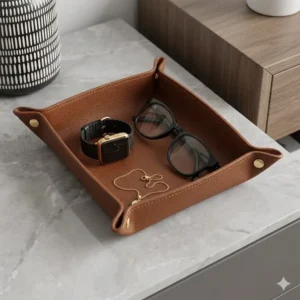
Top 5 Designer Catch All Trays: Expert Analysis
1. The Tech-Savvy Heirloom: Courant CATCH:3 Essentials
The Courant CATCH:3 Essentials is the ultimate fusion of classic haberdashery and modern power needs, featuring a weighted zinc alloy base wrapped in single-piece Italian leather.
Key Specifications & Practical Meaning:
-
3-Coil Qi-Certified Charging: This means you don’t have to fiddle with “dead zones” to get your phone to charge; the multi-coil system is much more forgiving than cheaper single-coil mats.
-
Weighted Non-Slip Base: At nearly 2 lbs, this tray won’t slide around when you toss a heavy set of car keys into it, protecting your nightstand from scratches.
Expert Opinion:
In my experience, this is the only “tech” tray that actually looks better with age. While most electronics look dated after two years, the pebble-grain leather here develops a patina that screams “old money.” It’s the perfect choice for the professional who wants to declutter their bedside table without sacrificing the ability to charge their iPhone and AirPods simultaneously. What most buyers overlook is the depth of the “catch” area; it’s shallow, meaning it’s better for a slim wallet and a watch rather than a bulky set of carabiners.
Customer Feedback Summary:
Users consistently praise the fast charging speeds and the “luxe” feel of the leather, though some note that the charging light can be a bit bright for sensitive sleepers…
-
Pros: Seamless wireless charging, premium weighted feel, exquisite packaging.
-
Cons: Higher price point, not ideal for large keyrings.
Price Range & Verdict:
In the $150–$175 range, this is a premium investment for those who value a “clutter-free” cord setup.

2. The Minimalist Muse: Yamazaki Home Tosca Accessory Tray
The Yamazaki Home Tosca Accessory Tray brings a slice of Tokyo minimalism to your entryway, combining powder-coated white steel with a warm wooden accent bar.
Key Specifications & Practical Meaning:
-
Two-Tier Vertical Design: By utilizing vertical space, this tray takes up a smaller footprint on your table while doubling the storage capacity for rings and keys.
-
Steel Construction: Unlike plastic or thin wood, the steel frame is incredibly durable and easy to wipe clean, making it a “buy it for life” utility piece.
Expert Opinion:
I often recommend the Yamazaki Home Tosca for apartment dwellers. In small spaces, horizontal surfaces are precious real estate. The wooden crossbar isn’t just for looks; it acts as a perfect hanging rack for sunglasses or even a spare face mask. It’s a “designer” piece in the sense that it follows the “form follows function” rule of Bauhaus design. If your home features white walls and light wood, this tray disappears into the decor while keeping you organized.
Customer Feedback Summary:
Reviews often highlight how “light and airy” it looks compared to bulky leather trays, with many using it specifically for jewelry organization…
-
Pros: Space-saving verticality, very affordable, clean aesthetic.
-
Cons: Can feel a bit “clinical” for some, wooden bar is not adjustable.
Price Range & Verdict:
Usually found in the $25–$40 range, it’s the best value for anyone wanting a modern, clean look.
3. The Ethical Statement: Parker Clay Everly Valet Tray
The Parker Clay Everly Valet Tray is a masterclass in rustic luxury, crafted from high-quality Ethiopian leather that supports sustainable job creation.
Key Specifications & Practical Meaning:
-
Reinforced Snap Corners: These allow you to unsnap the tray and lay it flat, which is a total game-changer for frequent travelers who want to maintain their “landing strip” in a hotel room.
-
Full-Grain Leather: This is the highest grade of leather available, ensuring the tray won’t peel or crack over time like “genuine leather” or bonded leather alternatives.
Expert Opinion:
What the spec sheet won’t tell you is how amazing this thing smells. It’s that deep, earthy leather scent that instantly upgrades the vibe of a home office. I love the Everly because it feels personal. It’s not a mass-produced piece of plastic; you can see the character in the hide. It’s the “designer” choice for someone who values soul and story over brand logos. It’s particularly effective on dark wood furniture where the cognac or black leather can create a sophisticated, moody contrast.
Customer Feedback Summary:
Buyers are obsessed with the “travel-ability” of the snaps and the fact that the purchase supports a B-Corp mission…
-
Pros: Travel-friendly flat-pack design, exceptional durability, ethical production.
-
Cons: Minimalist design lacks compartments, requires occasional leather conditioning.
Price Range & Verdict:
In the $60–$80 range, this tray offers the best “cost-per-year” value given its indestructible nature.

4. The Architectural Icon: Alessi Port Basket
The Alessi Port Basket is less of a tray and more of a sculpture, designed by Lluís Clotet to mimic the look of crumpled silver paper in polished stainless steel.
Key Specifications & Practical Meaning:
-
Cold-Pressed Stainless Steel: The edges are intricately folded using a complex industrial process, resulting in a tray that is lightweight yet incredibly rigid.
-
18/10 Mirror Polish: This level of finish means the tray acts like a mirror, reflecting light around the room and making it a focal point rather than just a storage item.
Expert Opinion:
Alessi is a titan in the world of Industrial Design, and the Port Basket is a museum-worthy piece. If your home is full of mid-century modern furniture or high-end art, a leather tray might feel too “safe.” This tray adds “texture” to a room. However, a word of advice: because it’s polished steel, it will show fingerprints. If you have kids with sticky hands, you’ll be polishing this more often than you’d like. It’s a high-maintenance beauty for a high-design home.
Customer Feedback Summary:
Users describe it as a “conversation starter,” though some mention it’s almost too pretty to actually put keys in…
-
Pros: Stunning visual impact, rust-proof, high resale value.
-
Cons: Prone to fingerprints, expensive for a “simple” tray.
Price Range & Verdict:
Expect to pay around $90–$120 for this piece of functional art.
5. The Industrial Anchor: Concrete Goods Hexagon Tray
The Concrete Goods Hexagon Tray is a hand-poured, minimalist dream for those who love the “loft” aesthetic and need something with serious weight.
Key Specifications & Practical Meaning:
-
Sealant-Coated Concrete: This prevents the porous concrete from absorbing oils from your hands or stains from a spilled coffee, keeping the finish pristine.
-
Cork-Padded Bottom: This is a vital feature for concrete; it ensures the heavy tray won’t scratch your glass or marble surfaces.
Expert Opinion:
I am a huge fan of concrete in the bedroom. There is something grounding about the weight of a Concrete Goods tray. Unlike leather which can feel “warm,” concrete is cool to the touch and adds a “brutalist” edge to a nightstand. It’s the perfect foil to a soft, upholstered bed frame. What I’ve noticed is that these trays are also incredibly heat-resistant, so if you’re prone to leaving a hot candle or a coffee mug near your “catch-all,” this material won’t warp or discolor.
Customer Feedback Summary:
Reviewers love the “substantial” feel and the unique variations in the concrete grain, though a few noted that it can chip if dropped on a hard floor…
-
Pros: Incredibly stable, unique texture, heat and stain resistant.
-
Cons: Heavy (not for travel), can chip if mishandled.
Price Range & Verdict:
At the $30–$50 range, it’s a rugged, stylish choice for modern industrial enthusiasts.
✨ Don’t Miss These Exclusive Deals!
🔍 Take your organization to the next level with these carefully selected products. Click on any highlighted item to check current pricing and availability. These tools will help you create an authentic home environment your family will love!

Practical Usage Guide: Mastering Your Landing Strip (Transformation)
Setting up a designer catch all tray is about more than just plopping it on a table. To truly transform your routine, you need a strategy. Here is my “30-Day Setup” guide to ensure your tray remains a tool for peace, not just another place for junk.
1. The “Golden Rule” of Content
Only items that leave the house with you should live in the tray. This includes your keys, wallet, sunglasses, and perhaps a lip balm. Do not let mail, loose change, or old receipts colonize the space. If it doesn’t have an “outbound” purpose, it doesn’t belong in the designer tray.
2. Maintenance & Longevity
-
For Leather: Every six months, apply a tiny amount of leather conditioner (like Chamberlain’s Milk). This keeps the fibers supple and prevents the “crackling” that can happen in dry, heated homes.
-
For Metal/Concrete: A simple micro-fiber cloth is your best friend. For stainless steel like the Alessi, a drop of olive oil on a cloth can actually help buff out stubborn fingerprints.
-
For Tech Trays: Use a compressed air canister once a month to blow dust out of the charging crevices. Dust is the silent killer of wireless charging efficiency.
3. Optimization Tricks
If you find your tray is getting too crowded, use the “Layering Technique.” Place your least-used item (like a spare car key) at the bottom and your most-used (phone/wallet) on top. If you use a Yamazaki vertical tray, use the top tier for “active” items and the bottom for “passive” items like watches or rings.
Problem → Solution Guide: Fix Your Clutter Culture (Transformation)
Even the most beautiful designer catch all tray can’t fix a bad habit without a little help. Here are the most common “clutter pain points” and how to solve them using the products we’ve discussed.
Problem: “My phone never actually gets charged because I forget to plug it in.”
-
The Solution: Switch to the Courant CATCH:3. By making the “landing spot” the charger itself, you remove the friction of finding a cable. It turns a chore into a subconscious habit.
Problem: “I have a tiny entryway and no room for a console table.”
-
The Solution: Look for a wall-mounted shelf or a vertical option like the Yamazaki Home Tosca. By stacking your essentials vertically, you can turn a 4-inch ledge into a fully functional organization hub.
Problem: “My keys make a loud, annoying ‘clatter’ that wakes up the baby/partner.”
-
The Solution: You need a soft-surface tray. The Parker Clay Everly or any high-quality felt-lined tray will dampen the sound of metal hitting the surface. It’s a small change that makes a huge difference in a quiet household.
How to Choose the Perfect Designer Catch All Tray
Choosing the right tray requires a balance of spatial awareness and aesthetic honesty. Don’t buy a concrete tray if you move your furniture every week, and don’t buy a tech tray if you prefer to keep your bedroom a “screen-free” zone.
-
Analyze Your Entryway Traffic: If you are a family of four, a small hexagonal tray won’t cut it. You’ll need a “mega-tray” or multiple coordinated trays to prevent a pile-up.
-
Match Your Hardware: Look at the doorknobs and light fixtures in your room. If you have brass accents, a leather tray with brass snaps (like the Parker Clay) will create a cohesive look.
-
Consider the “Thud” Factor: The sound an item makes when it hits the tray matters. Glass and metal are “bright” and “loud.” Leather and wood are “warm” and “muted.” Choose based on the mood of the room.
-
Evaluate Portability: If you travel for work, a snap-style valet tray is non-negotiable. It provides a sense of “home” in a sterile hotel room.
-
Tech vs. Analog: Do you need integrated charging? Remember that tech trays have cords. If you want a “cord-free” look on a floating shelf, go with a high-end analog tray like the Alessi.
Common Mistakes When Buying a Valet Tray
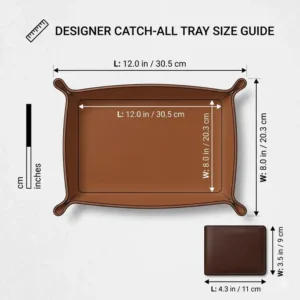
The biggest mistake I see is buyers choosing a tray that is too small. We often underestimate how much “stuff” we actually carry. Between a bulky key fob, a wallet, a pair of AirPods, and a watch, a 5-inch tray will be overflowing in seconds. Aim for at least 8-10 inches of surface area if you plan to hold more than two items.
Another pitfall is ignoring the base material. I’ve seen beautiful metal trays ruin expensive mahogany dressers because they didn’t have felt or cork feet. Always check the underside of the product. If it’s raw metal, stone, or ceramic, you’ll need to add your own adhesive felt pads to protect your furniture.
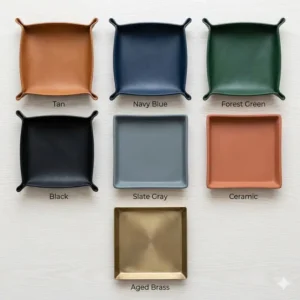
Finally, don’t get seduced by “trends” that don’t fit your lifestyle. Neon acrylic trays might look great on Instagram, but in a traditional or transitional home, they can look like “clutter” themselves. Stick to “timeless” materials—leather, wood, stone, and high-quality steel—to ensure your designer catch all tray remains relevant through 2030 and beyond.

Leather vs. Wood vs. Metal: The Material Deep Dive
When you invest in a designer catch all tray, you are primarily paying for the material and the craftsmanship.
Leather: The Classic Choice
Leather is the gold standard for a reason. It is naturally non-slip, sound-dampening, and it feels better the more you touch it. However, it is susceptible to water damage. If you plan to put your tray near a sink or a place where people might set down a wet umbrella, skip the leather.
Wood: The Organic Anchor
Wood (especially walnut or oak) brings a “living” element into the room. It’s great for mid-century modern aesthetics. The downside? Wood can be scratched by sharp keys over time. Look for trays with a “hardwax oil” finish which can be easily touched up at home.
Metal: The Modern Edge
Stainless steel or aluminum trays are nearly indestructible and very easy to sanitize. They are the best choice for high-traffic entryways where “dirt and grime” are a factor. However, they offer zero sound dampening, which can be a dealbreaker for some.
What to Expect: Real-World Performance Over 5 Years
A true designer piece should not look “worn out” after a few years; it should look “lived in.”
-
Year 1: The “New Car” phase. Everything is shiny. You’ll be careful about how you place your keys.
-
Year 3: The Patina phase. Leather will have deepened in color. Wood might have a few character marks. This is when the tray starts to feel like “yours.”
-
Year 5: The Heirloom phase. If you bought high-quality materials (Full-grain leather, 18/10 steel), the tray will still be structurally perfect. Cheaper “faux leather” or plastic trays will likely have peeled or cracked by this point.
This is why we emphasize the “Total Cost of Ownership.” A $150 leather tray that lasts 15 years costs you $10 a year. A $15 “pleather” tray that you replace every 18 months actually costs you more in the long run—and it ends up in a landfill.
The Psychology of the “Catchall”
Why are we so obsessed with these trays? Psychologically, a designer catch all tray acts as a “transition ritual.” It marks the boundary between the “outside world” (stress, work, commuting) and the “inner world” (home, family, rest). By placing your keys in a beautiful tray, you are symbolically “dropping” your burdens at the door.
In a world that feels increasingly digital and ephemeral, having a heavy, tactile object to interact with provides a much-needed “grounding” moment. It’s a micro-dose of mindfulness that happens every time you come home.
✨ Don’t Miss These Exclusive Deals!
🔍 Take your organization to the next level with these carefully selected products. Click on any highlighted item to check current pricing and availability. These tools will help you create an authentic home environment your family will love!
Conclusion
The designer catch all tray is the unsung hero of the organized home. It’s a small investment that pays dividends in both aesthetic joy and daily efficiency. Whether you choose the tech-forward elegance of the Courant CATCH:3, the architectural brilliance of Alessi, or the ethical warmth of Parker Clay, you are doing more than just buying a tray—you are designing a better flow for your life.
By choosing high-quality materials and understanding the specific needs of your space, you can turn a chaotic entryway into a serene gallery of your daily life. Remember: your home should rise to meet you when you walk through the door. A beautiful catchall is the first step in making that happen.
FAQs
❓ What is a designer catch all tray used for?
✅ It is a high-end organizer used to hold “everyday carry” items like keys, wallets, and phones. Unlike standard bins, it focuses on premium materials to enhance room decor while providing a specific “home” for essential items…
❓ Are leather catchall trays hard to maintain?
✅ Not at all. High-quality leather mostly needs to be kept dry and away from direct heat. A light application of leather conditioner every 6–12 months is usually enough to keep it looking new for decades…
❓ Can I use a designer catch all tray for jewelry?
✅ Absolutely. Many people use smaller designer trays on their vanity for “daily wear” jewelry like wedding bands or watches. The soft surface of a leather or felt tray is ideal for protecting precious metals…
❓ Which material is best for a heavy set of keys?
✅ For heavy keys, choose a tray with a “weighted” base like the Courant CATCH:3 or a solid material like Concrete Goods. This prevents the tray from tipping or sliding when the keys are tossed in…
❓ How do I clean a concrete tray?
✅ Use a damp, soft cloth with a tiny bit of mild soap. Avoid acidic cleaners (like vinegar or lemon) as they can eat through the protective sealant and leave permanent marks on the porous concrete…
Recommended for You
- 7 Best edc tray organizer Picks to Declutter Your Life Today!
- Everyday Carry Dump Tray: 7 Best Organizers to Save Your Sanity in 2026
- 7 Best hanging paper tray Options to Reclaim Your Workspace in 2026
Disclaimer: This article contains affiliate links. As an Amazon Associate, I earn from qualifying purchases. If you purchase products through these links, we may earn a small commission at no additional cost to you.
✨ Found this helpful? Share it with your friends! 💬🤗
[addtoany]
