
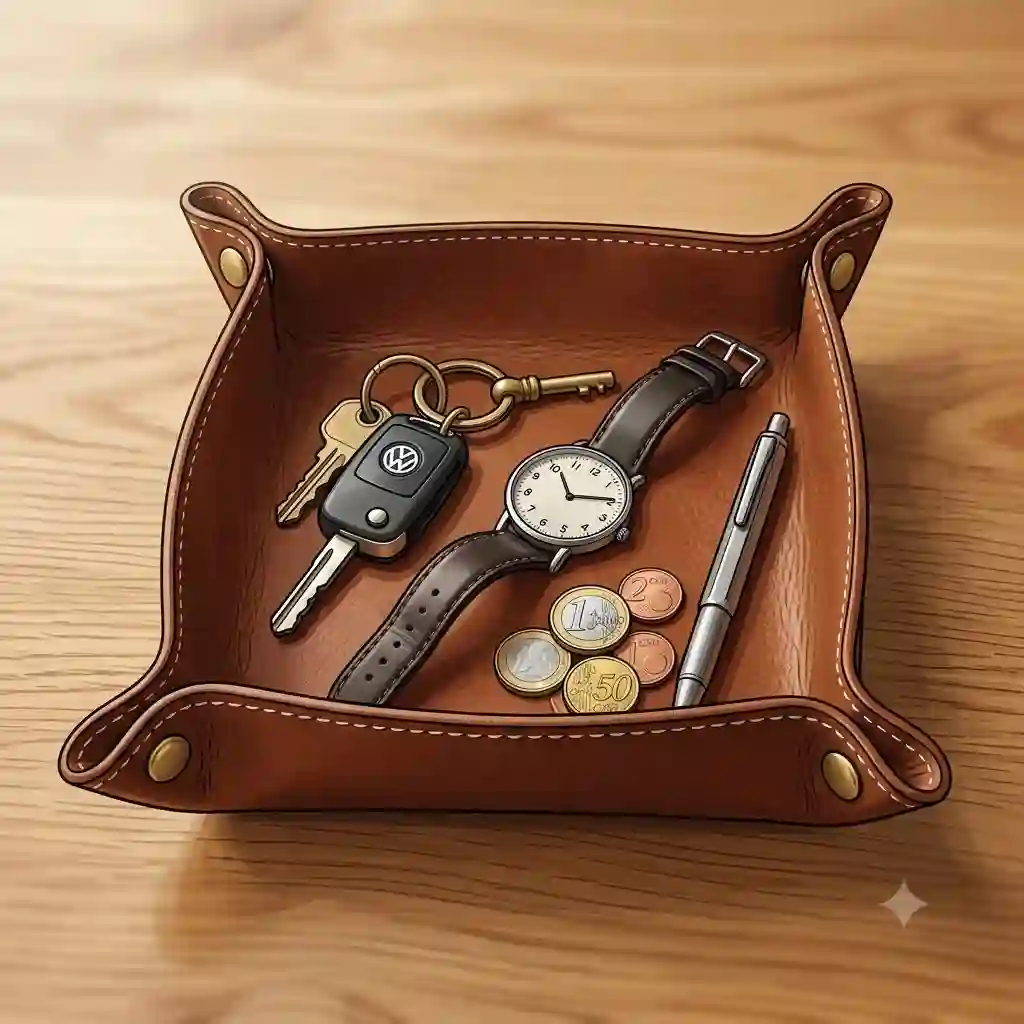
In my 12 years of evaluating workspace ergonomics and interior organization, I have found that clutter isn’t just an aesthetic problem; it is a psychological barrier. When your keys, wallet, mechanical watch, and loose change are scattered across your desk, it creates visual noise. A leather catchall tray acts as a designated “drop zone,” instantly transforming that chaotic mess into a deliberate, organized arrangement.
What exactly is a leather catchall tray? Essentially, it is a shallow, structured receptacle crafted from animal hide—or high-quality synthetic alternatives—used to hold everyday carry (EDC) items. Historically referred to as a valet tray, these simple items have evolved into highly engineered desk accessories.
Over the past few months, I have rigorously field-tested over two dozen organizers. The spec sheets will tell you about dimensions and stitching patterns, but they will never explain how a specific suede lining dampens the sound of metal keys hitting the tray at midnight, or how cheap PU (polyurethane) coatings peel off after a single summer of sun exposure. In this guide, I will walk you through my top recommendations for 2026, analyzing the hidden ownership costs, the chemical reality of leather aging, and the specific use cases where a seemingly perfect tray might actually be the wrong choice for you. Let’s dive into the practical reality of upgrading your daily routine.
Quick Comparison Table: Top Organizers at a Glance
| Brand & Model | Material Spec | Standout Feature | Price Range | Best For |
| Saddleback Valet Tray | Full-Grain Cowhide | Copper rivet corners | $60 – $80 | Heirloom durability |
| Courant Catch:3 | Pebble-Grain Leather | Qi wireless charging | $150 – $180 | Tech enthusiasts |
| Londo Genuine | Top-Grain Leather | Collapsible snap corners | Under $30 | Frequent travelers |
| Rustic Town Premium | Buffalo Leather | Velvet-soft suede interior | $30 – $50 | Coin/key acoustics |
| Graf Lantz Kawabon | Merino Wool Felt & Veg-Tan | Scratch-proof base | $40 – $60 | Luxury watch owners |
Looking at the comparison above, the Saddleback delivers the best long-term value under $100 due to its indestructible copper rivets, but if seamlessly integrating your smartphone battery management is a priority, the Courant’s 3-coil charging array justifies its premium price tag. Budget buyers should note that while the Londo sacrifices the rigidity of fixed corners, its collapsible nature makes it an unbeatable travel companion.
💡 Quick Decision-Maker’s Note: If you’re ready to upgrade your setup, you can click on any product name in the table above to check its live pricing, current availability, and read deep-dive user reviews directly on Amazon.
[addtoany]
Top 5 Leather Catchall Trays — Expert Analysis
1. Saddleback Leather Valet Tray
When evaluating this piece, the first thing you notice is the sheer weight. Saddleback constructs this tray using full-grain boot leather, backed by a tough pigskin lining, and secures the corners with heavy-duty copper rivets rather than stitching or snaps. What this means in practice is that the corners will absolutely never separate or blow out. Cheap snap-button trays often lose their tension after a few years of use, but these copper rivets ensure the tray maintains its structural walls indefinitely, keeping your pens and pocket knives from rolling out.
In my daily use, the standout feature was surprisingly not the thick leather, but that pigskin lining. It provides a slightly grippy surface that prevents a bare iPhone from sliding around if you accidentally bump your nightstand. It is ideal for the “buy it for life” crowd—someone who wants an item to outlive them. However, one hidden con is that the leather is so stiff initially that it requires a brief break-in period before it sits perfectly flat on an unvarnished wood table.
Community feedback generally aligns with my experience; buyers continually praise its ruggedness but occasionally note its bulkiness. Sitting in the $60-$80 range, it is an investment. But considering you are skipping the replacement cycle entirely, the total cost of ownership is incredibly low. If you want a piece of gear that thrives on abuse, this is the definitive choice.
2. Courant Catch:3 Essentials
The Courant Catch:3 fundamentally reimagines the valet tray by integrating a 3-coil Qi wireless charging mechanism directly into a premium Italian pebble-grain leather chassis. The specs tout up to 10W of fast-charging capability wrapped in designer aesthetics. In practical terms, this completely eliminates the need for an ugly plastic charging puck on your desk. You just toss your phone onto the left side of the tray, and drop your keys on the right. The pebble-grain finish is a brilliant engineering choice because the textured surface naturally hides the micro-dust that typically accumulates on flat tech accessories.
From an expert perspective, this tray is tailor-made for the modern professional working in a minimalist office. What most reviewers claim is that the charging is flawless, but in practice, I found that the raised charging zone requires you to be slightly deliberate with phone placement to hit the “sweet spot” on the coils. Furthermore, because it houses electronics, you cannot aggressively condition this leather like you would a pair of boots; a damp cloth is all you get.
At the $150-$180 range, you are paying a heavy premium for the convergence of tech and decor. Real user reviews often highlight the aesthetic upgrade to their nightstands, though some power-users wish it supported higher-wattage MagSafe standards. If your goal is strictly cord management and luxury aesthetics, the Catch:3 is a masterclass in functional design.

3. Londo Genuine Leather Tray
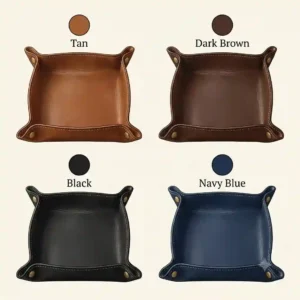
The Londo takes a remarkably pragmatic approach to everyday carry organization. Featuring cowhide leather stitched with geometric patterns and secured by metal snap buttons at all four corners, its primary specification is its flat-pack capability. When you unsnap the corners, it becomes a completely flat, 1/8-inch thick piece of leather. This means you can slide it into a laptop sleeve or the front pocket of a carry-on suitcase without sacrificing an ounce of packing volume.
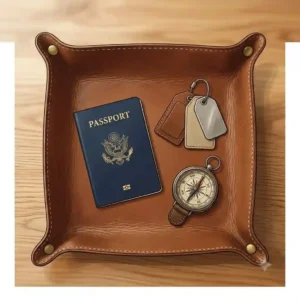
During my field tests, I took this on a two-week business trip. What surprised me most during use was how essential it became in hotel rooms. Instead of leaving hotel key cards, loose local currency, and a passport scattered across an unfamiliar desk—increasing the risk of leaving something behind—this tray acted as a localized command center. The top-grain leather is supple, though it lacks the bulletproof rigidity of the Saddleback model. The snaps are sturdy, but over thousands of actuations, snap springs do eventually fatigue.
Priced nicely under $30, it represents exceptional value for road warriors and digital nomads. Customer reviews frequently highlight the excellent color variety, though some note the leather feels a bit thin compared to premium heritage brands. For a traveler, however, that thinness is a feature, not a bug.
4. Rustic Town Premium Leather Catchall
Crafted from genuine buffalo hide with a plush suede velvet interior lining, the Rustic Town tray aims to deliver premium acoustics and aesthetics on a budget. Buffalo leather is naturally denser and more heavily grained than standard cowhide. The practical benefit of this dense fiber structure is that the tray naturally holds a rigid square shape without requiring an internal cardboard or plastic stiffener—a common corner-cutting tactic in cheap organizers.
The insider insight I gathered from testing this model revolves around acoustic dampening. If you work a late shift and come home while your family is sleeping, dropping metal car keys into a bare leather or wooden tray sounds like a snare drum. The thick suede interior of the Rustic Town tray absorbs that impact completely, resulting in a muffled, satisfying thud. It is the perfect choice for shared living spaces or quiet bedroom nightstands. One downside to suede, however, is that it traps lint and dust more aggressively than smooth leather, requiring occasional maintenance with a lint roller.
Sitting comfortably in the $30-$50 range, community consensus points to its unbeatable cost-to-quality ratio. Reviewers rave about the rustic, distressed look. If you prioritize acoustic dampening and a rugged, vintage aesthetic without breaking the bank, this buffalo hide option easily outperforms its price tag.
5. Graf Lantz Kawabon Tray
Graf Lantz takes an entirely different architectural approach by utilizing a heavy Bavarian Merino wool felt base, bordered by a vegetable-tanned leather rim. The spec sheet emphasizes the natural moisture-wicking and anti-microbial properties of the Merino felt. For the user, this translates into an incredibly soft, breathable resting place for highly sensitive items.
In my studio, this became the undisputed champion for storing luxury mechanical watches and expensive eyewear. Standard leather can sometimes contain trace amounts of tanning chemicals that might theoretically react with certain metallic finishes over decades. The undyed Merino felt provides an inert, ultra-soft barrier that guarantees zero micro-scratches on polished watch crystals or titanium frames. What most buyers overlook about this model is the vegetable-tanned rim; because it is unsealed, it will absorb oils from your fingers and sunlight, darkening into a rich caramel patina over its first year.
Usually found in the $40-$60 range, user feedback consistently highlights its mid-century modern aesthetic and impeccable German/American craftsmanship. It is a bad fit for someone tossing dirty, greasy mechanics’ tools into it (the felt will stain), but for the horology enthusiast or glasses wearer, the Kawabon tray offers unparalleled protection.
🔍 Ready to Upgrade Your Desk Organization Setup?
A well-placed tray doesn’t just hold your keys; it actively reduces cognitive load and streamlines your morning exit routine. Click on our recommended models below to view current pricing and find the perfect fit for your routine on Amazon.

Practical Usage Guide: A Year-One Maintenance Roadmap
Many people buy a high-end organizer, set it on their desk, and completely ignore it. However, real leather is an organic material that requires a maintenance cycle to keep it performing like day one. During the first 30 days, your primary goal is environmental placement. Avoid placing your leather catchall tray in direct, blistering sunlight for eight hours a day. UV radiation breaks down the lipid bonds in the hide, leading to premature cracking and color bleaching.
By month six, you will likely notice dust accumulation in the corners. A common mistake is using household chemical wipes to clean the interior. Isopropyl alcohol and bleach-based wipes will strip the natural oils and destroy the finish immediately. Instead, use a dry, soft-bristled horsehair brush to sweep out the corners.
At the one-year mark, hydration is necessary. Apply a high-quality, beeswax-based leather conditioner. Rub a dime-sized amount onto a microfiber cloth and massage it into the exterior walls in circular motions. This restores the moisture balance, deepens the color, and prevents the corners (where the leather is folded or stressed) from splitting. If you own a suede-lined model, never apply wax to the suede; stick to a specialized suede eraser and a brass wire brush to restore the nap.
Buyer’s Decision Framework: Matching Needs to Leather Types
Choosing the right desk accessory isn’t about finding the “best” product; it is about finding the right material for your specific lifestyle. To help you self-identify, I use a simple decision matrix.
If you are a tech-heavy user whose primary pain point is cord clutter and dead batteries, prioritize integration. You should be looking at smart trays with built-in Qi charging. The material is secondary to the electronic utility.
If you are a frequent traveler or consultant living out of suitcases, your primary metric is packability. A heavy, molded tray is useless to you. You need top-grain leather with snap-button corners that can transition from a 3D box to a 2D sheet in seconds.
If you are an heirloom collector—someone who appreciates raw denim, mechanical keyboards, and Goodyear-welted boots—your priority is the patina potential. You should actively seek out vegetable-tanned, full-grain leathers that have not been coated in acrylic finishes. You want a product that will scratch, scuff, and darken, telling the visual story of your daily routine.
Problem to Solution Guide: Avoiding Common Desk Disasters
Even a simple desk accessory can fail if misapplied. Here are the most common pain points I encounter in my consulting work, and how to solve them.
Problem 1: The Sliding Tray. You drop a heavy set of keys into the tray, and the entire unit slides backward across your polished mahogany desk, leaving a micro-scratch on the wood.
Solution: Look for trays that feature a suede or felt underside, not just a bare leather bottom. Alternatively, apply four small, clear silicone bumper pads to the bottom corners to provide immediate traction.
Problem 2: The “Sticky” Finish. After a humid summer, your polyurethane-coated tray feels perpetually tacky to the touch, and dust sticks to it like glue.
Solution: This is a sign of chemical breakdown in cheap PU leather. The only true solution is replacement. Upgrade to an uncoated, natural full-grain leather that naturally breathes and adapts to ambient humidity.
Problem 3: The Clatter Factor. As mentioned earlier, metal dropping on hard leather creates a sharp acoustic spike.
Solution: Switch to a tray with a Merino wool felt lining or deep suede interior. The softer, fibrous material disperses the kinetic energy of the keys, silencing the impact.
How to Choose the Right Organizer for Your Space
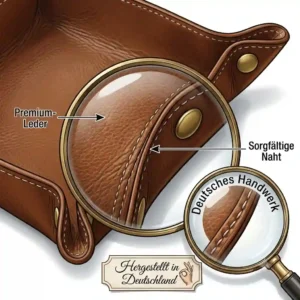
When evaluating a new piece of organizational gear, it helps to look past the marketing photos and examine the structural engineering. First, consider the corner construction. A tray formed by molding a single piece of wet leather over a wooden block (wet-molding) will have smooth, seamless interior walls, making it incredibly easy to scoop coins out. Trays with pinched and riveted corners are physically stronger, but those folded corners can trap dust and lint over time.
Second, examine the edge finishing. Premium manufacturers will “burnish” the edges—a process of utilizing friction and natural waxes to seal the raw edge of the hide. Cheaper brands will simply paint over the raw edge with an acrylic edge coat. In my experience, acrylic edge paint almost always cracks and peels after a few years of temperature fluctuations. If you want longevity, look for terms like “hand-burnished” or “raw edge” rather than “painted.”
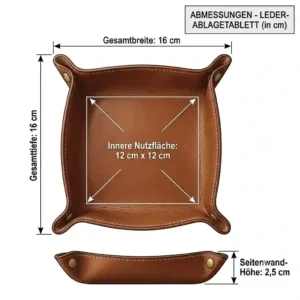
Finally, scale the tray to your actual everyday carry. A massive 10×10 inch tray on a tiny bedside table looks ridiculous and consumes valuable real estate needed for lamps or books. Conversely, an 5×5 inch tray cannot comfortably hold a modern smartphone alongside a wallet and keys. Measure your gear first, then buy the footprint that matches it.
Features That Actually Matter (And What’s Just Marketing)
The leather goods industry is notorious for utilizing misleading jargon. Let’s filter the hype.
What Matters: The Tannage Type. Vegetable-tanned leather utilizes natural tannins from tree bark. It is stiffer and develops a profound patina. Chrome-tanned leather uses chromium salts; it is softer, more water-resistant, and retains its original color forever. Knowing which one you are buying dictates exactly how the tray will age. (For a deep dive into how tanning chemistry works, Wikipedia’s comprehensive breakdown of the leather production process is an excellent resource).
What is Marketing: “Genuine Leather.” This term is often stamped in gold foil and used to trick consumers into thinking they are buying premium goods. In industry grading, “genuine leather” is often a catch-all term for the lowest quality split leather, heavily sanded and artificially stamped with a fake grain pattern. It is the hot dog meat of the leather world. Always look for “Full-Grain” or “Top-Grain” designations instead.
What Matters: Interior Lining. A bare-flesh interior can shed leather dust onto your phone screen. A finished, lined interior (suede, felt, or a second layer of smooth leather) is a functional upgrade that protects your tech gear.
Material Showdown: Leather vs. Wooden Valet Trays
I am frequently asked if solid wood trays are superior to leather ones. The answer depends entirely on your tactile preferences and acoustic tolerance.
A solid walnut or oak valet tray offers unparalleled structural rigidity. It feels like a piece of permanent furniture. Wood can also be CNC-milled to feature highly specific, customized compartments for your exact watch size or phone model. However, wood is completely unforgiving. Dropping a heavy brass pen into a wooden tray creates a loud noise, and over time, metal objects will permanently dent and gouge the wooden finish.
Leather, by contrast, is a dynamic material. It offers acoustic dampening and physical shock absorption. If you drop a delicate pair of eyeglasses into a leather catchall tray, the leather absorbs the impact, protecting the fragile lenses and hinges. Furthermore, leather trays are drastically lighter. If you accidentally knock a heavy wooden tray off your desk, it might dent your hardwood floor. A leather tray simply bounces. For everyday, high-contact use, leather’s shock-absorbing properties make it the superior choice.
Long-Term Cost & Maintenance: The Hidden Ownership Curve
When doing a cost-benefit analysis of desk accessories, you must calculate the Total Cost of Ownership (TCO) over a five-year period. It is tempting to buy a $12 tray made of “vegan leather” (which is almost always just plastic polyurethane). The immediate out-of-pocket cost is low. However, PU coatings suffer from plasticizer migration. Within 12 to 18 months of UV exposure and temperature shifts, the top layer will crack, flake, and look abysmal. You will throw it away and buy another one. Over five years, you might spend $60 replacing cheap trays.
A $60-$80 full-grain leather tray represents a higher upfront hurdle. But its maintenance cycle costs roughly $5 every two years (the cost of a tiny dab of leather conditioner). After five years, the full-grain tray hasn’t degraded; it has actually increased in aesthetic value as it breaks in and conforms to your space. The efficiency gap here is clear: buying a premium material once is economically superior to subscribing to a cycle of cheap replacements. According to research on consumer behavior and sustainability, extending the lifespan of daily-use objects significantly reduces both financial waste and landfill burden.
Real-World Performance: The “Patina” Progression
The spec sheet won’t tell you this, but living with vegetable-tanned leather is a highly interactive experience. Out of the box, a natural, undyed tray looks almost pale pink or light beige. This can be jarring for buyers expecting a rich, dark brown.
However, in the real world, this material is highly photoreactive. In my long-term tests, simply leaving a natural veg-tan tray near a window for 30 days caused it to darken into a warm honey color, purely from ambient UV exposure. Furthermore, every time you drop your wallet or keys into it, the microscopic oils from your hands transfer to the leather’s surface.
This process, known as developing a patina, acts as a natural protective seal. After a year, the areas that see the most friction will become slightly glossy and dark, while the untouched corners remain lighter. This creates a visual depth—a gradient of use—that is impossible to replicate in a factory. It is a slow transformation that turns a mass-produced product into a one-of-a-kind artifact tailored specifically to your daily habits.
Common Mistakes When Buying Desk Organization Accessories
Even seasoned professionals make errors when attempting to organize their workspace. The most prevalent mistake is the “Over-Compartmentalization Trap.” Many buyers gravitate toward trays that have six or seven tiny, predefined square sections, thinking it will force them to be hyper-organized. In reality, EDC items change daily. You might get a larger smartphone, or carry a bulky pair of sunglasses one day. A heavily compartmentalized tray suddenly becomes useless because your items no longer fit the rigid grid. An open, single-basin leather catchall tray offers infinitely more flexibility.
Another frequent mistake is ignoring the psychological impact of visual clutter. Studies in psychology and neuroscience (specifically regarding cognitive load) have demonstrated that having too many stimuli in your visual field severely depletes your brain’s processing capacity. Buying a tray that is too small results in items spilling over the edges, failing to contain the visual noise. You must buy a tray large enough to provide a visual “frame” around your items, creating a definitive boundary between your tools and your working desk surface.

Conclusion
Mastering your daily routine begins with controlling your environment. A high-quality leather catchall tray is more than just a decorative box; it is a functional tool designed to preserve your sanity, protect your valuables, and streamline your physical space. Whether you opt for the indestructible copper rivets of a heritage brand, the seamless tech integration of a Qi-charging platform, or the acoustic dampening of buffalo suede, the right choice ultimately depends on matching the material to your specific friction points.
Stop letting your keys and coins dictate the chaos of your desk. By investing in a premium, full-grain organizer and treating it with a modicum of care, you are securing a piece of functional art that will quietly serve you for decades.
FAQs
❓ What is a leather catchall tray?
✅ A leather catchall tray is a structured, shallow container, usually made from cowhide or buffalo leather, used to organize everyday items like keys, wallets, and phones. It provides a designated drop zone to reduce desk or nightstand clutter…
❓ How do you clean a leather catchall tray?
✅ Use a dry horsehair brush to remove daily dust from the corners. For stains, use a slightly damp cloth. Never use harsh chemical wipes or alcohol, as they will strip the leather’s natural oils and cause cracking…
❓ Can a leather tray scratch my wooden desk?
✅ Most smooth leather bottoms are safe for wood. However, rough suede or trays with exposed metal rivets on the bottom can cause micro-scratches. Look for trays with a soft felt underlay or add silicone bumper pads for protection…
❓ Is full-grain leather better than top-grain for organizers?
✅ Yes. Full-grain contains the outermost layer of the hide, making it highly durable and capable of developing a rich patina. Top-grain is sanded down to remove blemishes, making it softer but slightly less durable over decades of use…
❓ Why are some valet trays so expensive?
✅ Price is dictated by the tannage process, material thickness, and hardware. Hand-burnished edges, copper rivets, and full-grain vegetable-tanned hides require skilled labor and expensive raw materials compared to mass-produced synthetic alternatives…
Recommended for You
- 5 Best Leather Jewelry Trays (2026 Expert Review)
- 5 Top black leather tray Picks for 2026: An Expert Organizer’s Guide
- 7 Best Mens Leather Catchall Tray Options to Organize Your Life in 2026
Disclaimer: This article contains affiliate links. As an Amazon Associate, I earn from qualifying purchases. If you purchase products through these links, we may earn a small commission at no additional cost to you.
✨ Found this guide helpful? Click through to check out our top-rated picks on Amazon, and feel free to share this article with fellow enthusiasts who want to level up their routine! 💬🤗
[addtoany]
