
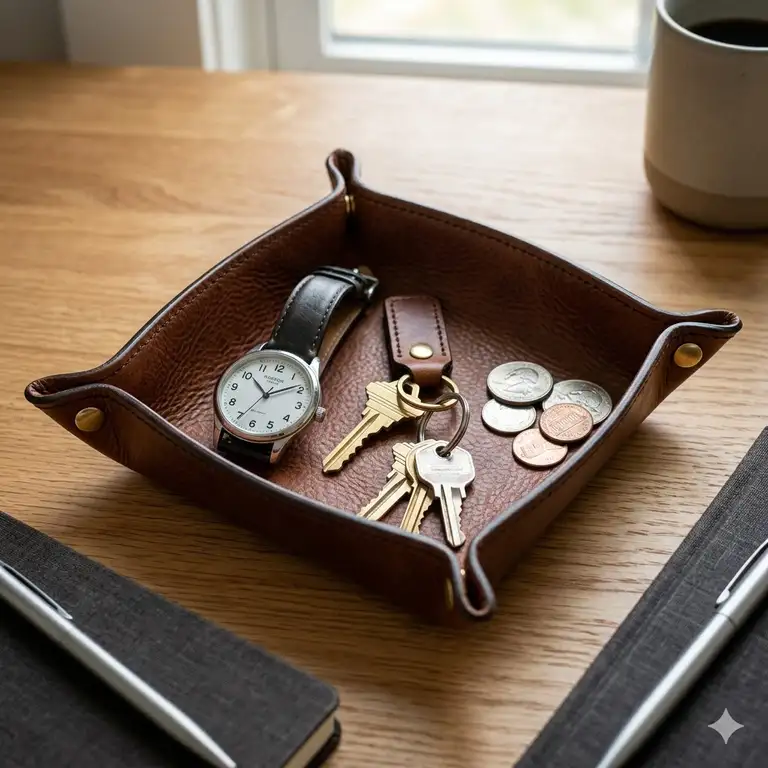
A leather catch all is more than just a piece of shaped hide; it is the tactical command center for your daily essentials. In the fast-paced environment of 2026, where we juggle biometric fobs, smart wallets, and traditional keys, having a designated “landing zone” is the difference between a seamless morning and a frantic search under the sofa cushions. These trays, often called valet trays, serve as a physical ritual site where you transition from the chaos of the outside world to the sanctuary of your home.
What is a leather catch all? Technically, it is a shallow container, typically made of vegetable-tanned or chrome-tanned leather, used to store small personal items like keys, coins, and watches. Beyond the utility, it is a statement piece. High-quality leather develops a patina over time, meaning your tray will actually look better in 2030 than it does today. It absorbs the oils from your hands and the scuffs from your keys, creating a unique narrative of your daily life.
In this guide, we dive deep into the best options available on Amazon this year. We aren’t just looking at aesthetics; we are analyzing stitch density, leather grade, and the structural integrity of those corner snaps. Whether you are a minimalist looking for a sleek desk accessory or a rugged adventurer needing a place for a heavy brass EDC (Every Day Carry) kit, there is a leather catch all designed specifically for your lifestyle.
Quick Comparison: Top 2026 leather catch all Trays
| Product Name | Primary Material | Portability | Best For | Price Range |
| Saddleback Leather Valet Tray | Full-Grain Leather | High (Lays Flat) | Heritage Longevity | $75 – $95 |
| Parker Clay Omo Tray | Premium Ethiopian Leather | Medium | Ethical Fashion | $50 – $70 |
| Hide & Drink Catchall | Suede/Rustic Leather | Medium | Budget Ruggedness | $20 – $35 |
| Shinola Leather Valet Tray | Navigator Leather | Low (Rigid) | Luxury Decor | $110 – $140 |
| Billykirk No. 286 | Latigo Leather | Medium | Artisan Craft | $65 – $85 |
Expert Analysis: The data above reveals a clear divide between “travel-ready” trays that unsnap to lay flat and “stationary” luxury trays that use rivets or molded leather. If you commute frequently between a home office and a corporate suite, the Saddleback’s flat-pack design is superior. However, for a permanent nightstand fixture, the rigid structure of the Shinola offers a more premium, furniture-like feel that doesn’t “creep” across the table surface.
💬 Just one click — help others make better buying decisions too! 😊
[addtoany]
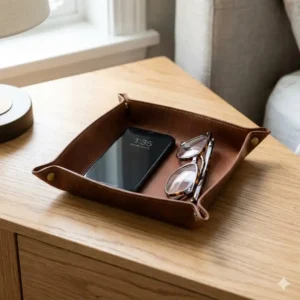
Top 5 leather catch all Trays: Expert Analysis for 2026
1. Saddleback Leather Valet Tray — The Heirloom Choice
The Saddleback Leather Valet Tray is a masterclass in over-engineering. Constructed from a single piece of thick, full-grain leather, it features four heavy-duty snaps that allow it to transform from a 2D sheet into a 3D vessel in seconds.
The full-grain leather used here is the “top shelf” of hides, containing the strongest fibers of the cowhide. In practical terms, this means it won’t tear or stretch thin over years of holding heavy metal objects. Most “genuine leather” alternatives will begin to crack at the fold points within eighteen months, but the Saddleback is built to last a century. I personally find that the “Tobacco” finish ages into a beautiful mahogany hue that hides scratches exceptionally well.
Customer feedback frequently highlights the “break-in” period. Users note that the leather is initially stiff, requiring a bit of muscle to snap the corners, but it settles into its shape perfectly after a week. It’s the quintessential choice for someone who values “Buy It For Life” (BIFL) durability over delicate aesthetics.
-
Pros: Incredible 100-year warranty; heavy-duty full-grain construction; travel-friendly flat-pack design.
-
Cons: Very stiff out of the box; heavy weight might bother ultralight travelers.
-
Price Range: Around $85.
-
Verdict: Best for the “rugged professional” who wants an indestructible landing pad for their gear.
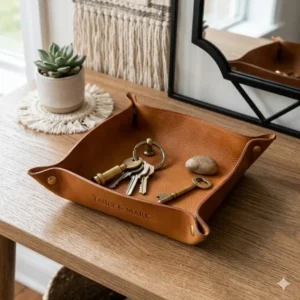
2. Parker Clay Omo Valet Tray — The Ethical Luxury Pick
The Parker Clay Omo Valet Tray offers a more refined, supple feel compared to the ruggedness of Saddleback. Sourced and crafted in Ethiopia, this tray utilizes premium sustainable leather that feels buttery to the touch but maintains enough rigidity to hold its form.
The expert takeaway here is the “finished edge” work. Unlike raw-edge trays that can fray over time, Parker Clay uses a meticulous binding process that gives it a clean, architectural look suitable for high-end office desks. This is important because raw leather can sometimes “shed” tiny fibers onto felt-lined surfaces; you won’t have that issue here.
Reviews often mention how well it complements modern tech. It doesn’t look out of place next to an aluminum laptop or a glass smartphone. If you are concerned about the “social footprint” of your purchases, this is the gold standard for 2026.
-
Pros: Supports ethical employment in Ethiopia; beautiful finished edges; soft interior is gentle on watch crystals.
-
Cons: Lighter colors may show water spots; snaps are smaller than competitor models.
-
Price Range: $55 – $65.
-
Verdict: Best for the style-conscious professional who prioritizes ethical sourcing and sleek design.
3. Hide & Drink Leather Catchall — The Rustic Value King
If you want the authentic smell and feel of real leather without the triple-digit price tag, the Hide & Drink Leather Catchall is the industry disruptor. Made from “Bourbon Brown” rustic leather, it leans into the natural imperfections of the hide.
What most buyers overlook here is the “flesh side” (the fuzzy underside) of the leather. Hide & Drink leaves this side exposed on the interior of the tray, which acts as a natural non-slip surface for your items. While premium brands might line the interior with pigskin or suede, this single-layer approach keeps the cost down while maintaining a heavy, satisfying “clunk” when you drop your keys.
Customers rave about the value-to-quality ratio. It feels “real” in a way that many department store valet trays—often made of “bonded leather” (which is essentially leather sawdust and glue)—simply cannot match.
-
Pros: Extremely affordable; genuine rustic aesthetic; handmade quality.
-
Cons: Thinner leather than premium brands; snaps can occasionally feel loose.
-
Price Range: Under $30.
-
Verdict: Best for students or those looking for a high-quality gift that doesn’t break the bank.
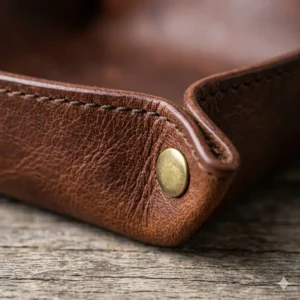
4. Shinola Leather Valet Tray — The Executive Desk Essential
Based in Detroit, Shinola has become synonymous with American luxury. Their Shinola Leather Valet Tray is a rigid, molded piece that foregoes snaps for a permanent, structural form.
The technical difference here is the use of “Navigator” leather. This leather is infused with oils and waxes during the tanning process, making it highly resistant to the moisture and oils from your skin. For an executive, this means the tray won’t get those dark, greasy spots where you habitually grab it. The rigid walls also ensure that if you toss your keys in from a distance (we all do it), they won’t fly out the other side.
Expert opinion: This tray is a “furniture piece.” It is not meant for travel, but it excels as a centerpiece on an oak dresser. The debossed Shinola lightning bolt is a subtle nod to those who know the brand’s heritage in watchmaking and leathercraft.
-
Pros: Highly water and oil resistant; permanent rigid structure; iconic American branding.
-
Cons: Not portable (cannot lay flat); highest price point on our list.
-
Price Range: $120 – $135.
-
Verdict: Best for the established professional looking to anchor their nightstand with a luxury icon.
5. Billykirk No. 286 Valet Tray — The Artisan’s Choice
Billykirk was at the forefront of the heritage leather movement long before it was trendy. Their Billykirk No. 286 Valet Tray uses US-sourced Latigo leather, which is a hybrid tannage that offers the strength of vegetable tanning with the flexibility of chrome tanning.
The standout feature here is the brass rivet construction. While snaps allow for flat-packing, rivets provide a permanent, “fail-proof” corner. If you’ve ever had a snap fail on a cheap tray, you’ll appreciate the finality of a solid brass rivet. The 286 is also slightly larger than the average tray, making it the better choice for those who carry a bulky set of keys and a large-format smartphone.
Customer feedback often centers on the “character” of the tray. It feels like something pulled out of a 1940s workshop. It’s an artisan tool for your modern life.
-
Pros: Solid brass rivet construction; larger surface area; unique Latigo leather blend.
-
Cons: Cannot be flattened for travel; edges are raw (though well-burnished).
-
Price Range: $70 – $80.
-
Verdict: Best for the “heritage enthusiast” who prefers a permanent, heavy-duty organizer.
✨ Don’t Miss These Exclusive Deals!
🔍 Take your organization to the next level with these carefully selected products. Click on any highlighted item to check current pricing and availability. These tools will help you create authentic home systems your family will love!
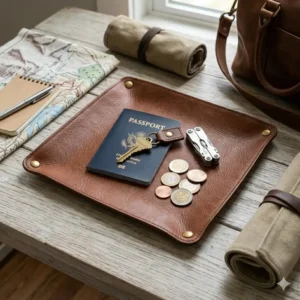
The 3-Zone Nightstand Method: A Practical Usage Guide
Buying a leather catch all is only the first step. To truly transform your space, you need a system. Most people simply throw everything into the tray, which eventually leads to a “mini-junk drawer” effect. According to organization experts at the National Association of Productivity & Organizing, spatial boundaries are key to mental clarity.
Step 1: The Daily “Dump” (Zone 1)
Place your tray within arm’s reach of your front door or on the immediate corner of your nightstand. This is Zone 1. Your keys and wallet should land here every single time you enter the house. By creating this “muscle memory,” you eliminate the “where are my keys?” panic that costs the average American 2.5 days per year in lost time.
Step 2: Tech Integration (Zone 2)
In 2026, our trays often house wireless charging pads. If your leather catch all is large enough, place a slim MagSafe or Qi charger inside. This ensures your phone is charging while it’s “put away.” Look for trays with “cord cutouts” or simply use a tray with low enough walls that the cable can drape over the side without tilting the tray.
Step 3: The Weekly Purge (Zone 3)
Once a week, usually Sunday evening, clear out the tray entirely. Remove receipts, loose change, and gum wrappers. Wipe the leather with a soft, dry microfiber cloth. This prevents “grit” (like sand from your pockets) from scratching the leather or your expensive watch crystals.
Problem → Solution: Fixing Common Organization Pitfalls
Many people hesitate to buy leather organizers because they’ve had bad experiences with “floppy” faux-leather or trays that stain their furniture. Here is how to solve those common pain points:
-
Problem: My tray slides around every time I drop my keys.
-
Solution: Look for a leather catch all with a “suede” or “flesh-side” bottom. Smooth, highly polished leathers are slippery. If you already own a slippery tray, apply a small strip of “museum gel” or a tiny felt pad to the underside of the snaps.
-
-
Problem: I’m worried the leather will scratch my $5,000 watch.
-
Solution: Choose a lined tray. While the Saddleback is rugged, the Parker Clay or a tray lined with microfiber/suede offers a softer landing. Alternatively, place a small piece of velvet at the bottom of a rugged tray for your timepiece.
-
-
Problem: My tray looks dull and “dried out.”
-
Solution: Leather is skin. It needs hydration. Every six months, apply a tiny amount of leather conditioner (like Chamberlain’s Leather Milk). This keeps the fibers supple and prevents the corners from cracking—especially if you live in a dry climate or use the heater frequently in the winter.
-
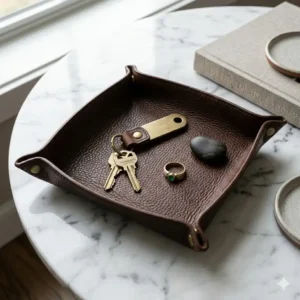
How to Choose the Right leather catch all for Your Needs
Selecting a tray involves more than picking a color. You need to consider the “tannage” and the “structure” to ensure the product meets your specific lifestyle demands.
1. Identify Your Leather Type
-
Vegetable Tanned (Veg-Tan): This is the traditional method using plant tannins (bark, leaves). It’s eco-friendly and creates a stiff leather that patinas beautifully. If you want that “old-world” look that darkens over time, go for veg-tan.
-
Chrome Tanned: This uses chromium salts. It results in a softer, more color-fast leather. If you want a tray that stays the exact same “Navy Blue” or “Slate Grey” for five years, chrome-tanned is your best bet.
2. Snap vs. Rivet vs. Molded
If you travel for work, snaps are non-negotiable. Being able to lay the tray flat in your suitcase takes up zero room. However, if this is for a “forever home” on your entryway table, riveted or molded trays offer a more architectural, high-end look. Snaps can eventually lose their tension; rivets never do.
3. Size Matters (Measure Your Gear)
Measure your largest item—usually a smartphone or a long “trucker” wallet. A standard 5×5 inch tray is great for keys and a wedding ring, but it will feel cramped if you’re trying to fit a 6.7-inch iPhone Pro Max inside. Look for “XL” versions (usually 8×8 inches) if you’re a heavy EDC carrier.
Faux Leather vs. Real Leather: The Long-Term Cost Analysis
In the short term, a $10 “PU leather” (Polyurethane) tray from a big-box retailer looks fine. However, in 2026, savvy consumers are looking at the “Total Cost of Ownership.”
Faux Leather (PU/Vegan):
-
Life Expectancy: 12–18 months.
-
Degradation: Faux leather is essentially plastic bonded to fabric. The edges will “peel” and the “leather” will flake off, leaving unsightly white fabric showing through. It cannot be repaired or conditioned.
-
Cost per year: If you replace it every year, you spend $50 over five years.
Real Leather:
-
Life Expectancy: 20–100 years.
-
Degradation: It doesn’t degrade; it “evolves.” Scratches can be buffed out with a thumb. It becomes a family heirloom.
-
Cost per year: A $75 Billykirk tray costs just $7.50 over a decade.
Analysis: From a sustainability and financial standpoint, the “real” leather catch all is the clear winner. PU leather contributes to microplastic pollution and landfill waste, whereas high-quality leather is a byproduct of the food industry that can last a lifetime if maintained properly.
Trends for 2026: The Rise of the “Tech-Integrated” Valet
As we move deeper into 2026, the leather catch all is evolving. We are seeing a massive trend toward “Mixed Media” trays—combining leather with wood or metal. For example, a walnut wood base with a leather inlay provides the rigid protection of wood with the soft, scratch-free surface of leather.
Another rising trend is “Modular Catchalls.” These are sets of smaller trays that nest within a larger one. This allows you to separate your “dirty” items (coins, keys) from your “clean” items (lip balm, AirPods). If you are someone who hates the sound of metal jingling against metal, a modular system with felt dividers is the ultimate organizational luxury.
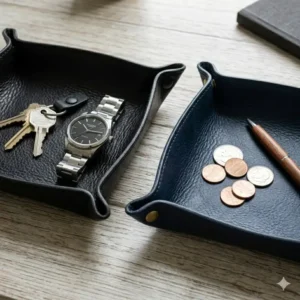
Features That Actually Matter (And Those That Don’t)
Marketing departments love to throw around buzzwords. Here is what actually impacts your daily use:
-
Stitch Density: Look for high “Stitches Per Inch” (SPI). A higher SPI usually indicates a slower, more careful manufacturing process and a stronger bond.
-
Edge Painting: High-end trays like Shinola paint their edges to seal the leather. This prevents moisture from seeping into the grain. Cheap trays leave edges “fuzzy,” which can absorb coffee spills and swell.
-
Weight: A heavy tray stays put. If a tray feels light like paper, it’s likely “corrected grain” or bonded leather. A real full-grain tray should have some “heft” to it.
What doesn’t matter? “Hand-stitched” isn’t always better than “machine-stitched.” Modern heavy-duty sewing machines used by brands like Saddleback provide more consistent tension than a human hand can achieve over a long production run.
The Gift of Organization: Why Trays are the Perfect 2026 Gift
In a world of digital subscriptions and ephemeral gadgets, a physical, tactile gift like a leather catch all stands out. It is the perfect gift for:
-
The Graduate: To help them build adult habits in their first apartment.
-
The Third Anniversary: Traditionally the “Leather” anniversary.
-
The New Homeowner: A practical “welcome home” gesture.
Because leather is a natural product, no two trays are identical. This inherent uniqueness makes it feel personal and “curated” rather than mass-produced.
Sustainable Leather: What to Look For in 2026
Sustainability is no longer a “nice-to-have”; it’s a requirement. When shopping for a leather catch all, look for the Leather Working Group (LWG) certification. This ensures the tannery meets strict environmental standards regarding water usage and chemical disposal.
Brands like Parker Clay and Saddleback are transparent about their supply chains. Avoid “mystery leather” from unverified sellers that could be processed with harmful chemicals. By choosing LWG-certified or vegetable-tanned leathers, you are supporting a more circular and responsible economy.
✨ Don’t Miss These Exclusive Deals!
🔍 Take your organization to the next level with these carefully selected products. Click on any highlighted item to check current pricing and availability. These tools will help you create authentic home systems your family will love!
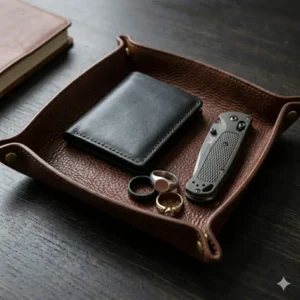
Conclusion: Investing in Your Daily Flow
At the end of the day, a leather catch all is a small investment that yields massive dividends in daily peace of mind. It’s the difference between walking out the door with confidence and a ten-minute scavenger hunt for your car keys. Whether you choose the indestructible Saddleback, the ethical Parker Clay, or the budget-friendly Hide & Drink, you are choosing to bring a bit of order to a chaotic world.
Remember to consider your specific use case: Do you need to travel with it? Does it need to hold a massive watch collection? Or is it simply a place to drop your loose change? By matching the leather type and construction to your lifestyle, you ensure that your tray won’t just be another piece of clutter—it will be the solution to it.
FAQs
❓ How do I clean a leather catch all without ruining it?
✅ Use a damp (not dripping) cloth with a tiny drop of pH-balanced leather cleaner. Never use dish soap or baby wipes, as the chemicals can strip the natural oils and cause the leather to crack over time…
❓ Can I use a leather catch all for my bathroom counter?
✅ Only if it is “Chrome Tanned” or specifically treated with a water-resistant finish. Pure vegetable-tanned leather will “water spot” if it gets wet. For bathrooms, look for trays with “finished” edges to prevent moisture absorption…
❓ What size catch all do I need for a large smartphone?
✅ You should look for a tray with internal dimensions of at least 7 inches by 4 inches. Most “Standard” trays are 5×5, which is too small for modern “Plus” or “Max” sized phones. Always check the “interior” dimensions…
❓ Will the snaps on a leather tray wear out over time?
✅ High-quality brass or steel snaps can last for decades. However, if you unsnap and resnap them five times a day, they may eventually lose tension. For heavy travel, choose brands like Saddleback that use industrial-grade hardware…
❓ Is “Genuine Leather” the best quality for a catch all?
✅ Actually, “Genuine Leather” is often a marketing term for one of the lowest grades of real leather. For the best durability and patina, look for “Full-Grain” or “Top-Grain” leather. These use the strongest part of the hide…
Recommended for You
- 7 Best Mens Leather Catchall Tray Options to Organize Your Life in 2026
- 7 Best Leather Dump Tray Models for 2026: Organize Your EDC Today!
- Key catchall: 7 Best Trays to Stop Losing Your Keys in 2026!
Disclaimer: This article contains affiliate links. As an Amazon Associate, I earn from qualifying purchases. If you purchase products through these links, we may earn a small commission at no additional cost to you.
✨ Found this helpful? Share it with your friends! 💬🤗
[addtoany]
